Indonesia Begins First EV Battery Exports in USD 10B Push
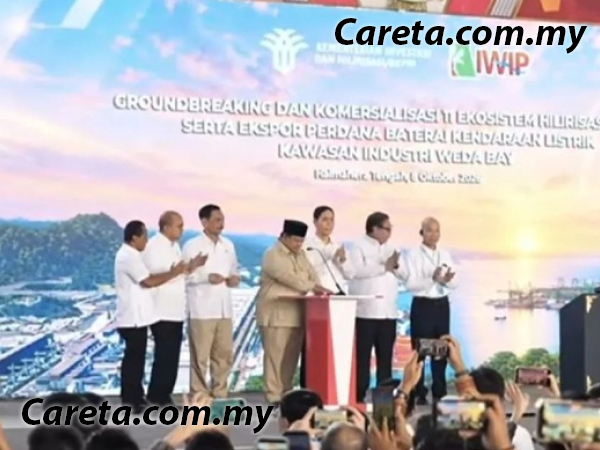
Indonesia launched its inaugural commercial electric vehicle (EV) battery exports alongside 11 downstream industrial initiatives on 08 October 2026 at the Indonesia Weda Bay Industrial Park (IWIP) in Central Halmahera, North Maluku. Managed within regional supply networks feeding into Southeast Asian automotive sectors—including Malaysian EV adoption—the project scales battery raw materials, cell assembly, and recycling ecosystems. The enterprise directly addresses battery component supply security for regional manufacturers and importers supporting standard 240V, Type 2 charging infrastructure across ASEAN markets.
Key Facts
| Attribute | Value |
| Launch Date | 08 October 2026 |
| Total Investment (11 Downstream Projects) | USD 10.2 billion (approx. RM 44.88 billion) |
| Commercial Operations Investment | USD 3.4 billion (approx. RM 14.96 billion) |
| New Construction Investment | USD 6.8 billion (approx. RM 29.92 billion) |
| Total Cumulative IWIP Investment | USD 20 billion to date; expanding to USD 27 billion (approx. RM 118.80 billion) |
| Direct Employment Created (11 Projects) | Over 10,000 jobs |
| Current Total IWIP Workforce | 117,000 workers |
| Industrial Tenants at IWIP | 52 tenants (including Glencore, Trafigura, Australian and Indian investors) |
| Export Value Generated by IWIP | Approximately USD 11 billion (approx. RM 48.40 billion) |
| Combined IWIP and IMIP Export Value | USD 28 billion (approx. RM 123.20 billion; approx. 10% of Indonesia's total exports) |
| Regional Power & Plug Compatibility Context | Compatible with 240V, UK-style 3-pin plug (BS 1363) charging standard grids across ASEAN |
What Do the 11 Downstream Industrial Projects Encompass?
The 11 industrial projects comprise four facilities entering immediate commercial operation and seven newly initiated construction developments focused on a complete EV battery ecosystem. These encompass nickel-based battery materials, EV battery manufacturing, battery separators, electrolytes, electrolytic aluminium, heavy machinery, electric haul trucks for mining, and photovoltaic glass for solar applications.
According to Indonesia's Investment and Downstream Minister Rosan Roeslani, the projects split into USD 3.4 billion (approx. RM 14.96 billion) for the four operating facilities and USD 6.8 billion (approx. RM 29.92 billion) for new developments. The expansion also incorporates closed-loop battery recycling infrastructure to secure critical raw materials across the supply chain.
"The first export of EV batteries today is a crucial step. This is concrete proof that our downstream industrialisation strategy is correct, and we will continue to implement it to the best of our ability."
Presiden Prabowo Subianto, Antara News / Berita Harian / Bernama
Indonesia's USD 10.2 billion (approx. RM 44.88 billion) downstream launch establishes end-to-end production covering nickel extraction, electrolyte chemistry, battery assembly, and closed-loop recycling.
How Do IWIP and IMIP Impact Regional ASEAN Supply Chains?
The industrial hubs of IWIP in North Maluku and IMIP in Central Sulawesi account for USD 28 billion (approx. RM 123.20 billion) in combined exports, representing approximately 10 percent of Indonesia's national export output. IWIP alone houses 52 industrial tenants, securing global commodity partnerships with international firms such as Glencore and Trafigura alongside Australian and Indian investors.
Minister Rosan Roeslani reported that downstream manufacturing now generates nearly half of North Maluku's gross domestic product, formalising a structural shift from raw resource extraction to high-value industrial production. Across the first half of 2026, realised national investment reached Rp1,010.6 trillion (up 7.2 percent), with downstream industrial projects contributing 30 percent of total capital expenditure and over 75 percent situated outside Java.
Combined exports from the IWIP and IMIP industrial hubs total USD 28 billion (approx. RM 123.20 billion), constituting approximately 10 percent of Indonesia's total export economy.
How Does Indonesia's Battery Export Drive Relate to Malaysian Users?
For Malaysian consumers transitioning to electric vehicles in urban settings like Kuala Lumpur condominiums, regional battery manufacturing supports supply chain accessibility, spare parts logistics, and lower replacement cell costs. Local Malaysian EV charging relies on 240V UK-standard domestic connections, Sirim-certified wallboxes, and tropical thermal management systems designed for persistent ambient humidity above 80 percent.
Localised regional cell production lowers logistical transport distances across the Malacca Straits, expediting cell replacements and battery repairs for high-mileage urban commuters. As regional trade integrates under ASEAN framework standards, raw-material refining and cell assembly in Halmahera ensure regional vehicle supply chains comply with local voltage, tropical cooling requirements, and Sirim safety protocols.
Regional EV battery supply chains in Southeast Asia reduce freight lead times and component costs for Malaysian drivers operating electric vehicles on 240V domestic power networks.
Common Questions
Will Indonesian-manufactured EV batteries comply with Malaysian 240V domestic charging standards?
Yes. EV battery cells produced in regional facilities are integrated into vehicle architectures designed for global standard AC Type 2 and DC CCS2 charging systems, which connect seamlessly to standard Malaysian 240V, 50Hz single-phase and 415V three-phase electrical infrastructure.
What types of materials and components are produced at Weda Bay?
The projects encompass nickel battery materials, finished EV battery cells, separators, electrolytes, electrolytic aluminium, heavy electric transport machinery, and photovoltaic solar glass, alongside future battery recycling units.
How many jobs and international partners are involved in IWIP's expansion?
The 11 projects create over 10,000 jobs, adding to IWIP's 117,000 existing workforce. The park hosts 52 multinational tenants, including global commodity traders Glencore and Trafigura, alongside industrial investors from Australia and India.
Sources and Methodology
This article synthesises reporting from Careta, Antara News, and Berita Harian/Bernama regarding the commercial launch events held on 08 October 2026 at the Indonesia Weda Bay Industrial Park (IWIP). Financial values originally reported in United States Dollars (USD) were converted to Ringgit Malaysia (RM) at an exchange rate of USD 1.00 = RM 4.40 for local market context. Malaysian technical considerations incorporate national standard single-phase 240V power requirements (MS IEC 60038) and Sirim electrical safety certification benchmarks. This article was last updated on 09 October 2026. Information specific to Malaysia was verified against local electrical infrastructure standards and automotive distribution data.