Ipoh Accident Victims' Families Get RM275K PERKESO Aid
PERKESO Skim Lindung 24 Jam: What It Is and How It Protects Malaysian Workers
PERKESO (Pertubuhan Keselamatan Sosial), also known as SOCSO, is Malaysia’s national social security organisation. Its Skim Lindung 24 Jam (24-Hour Protection Scheme) provides employment-injury and invalidity coverage to workers regardless of whether an accident occurs during work hours. As of September 2026, this scheme enabled two families in Ipoh to receive over RM275,000 in combined benefits after the tragic loss of their young breadwinners.
The scheme is administered under Malaysia’s Employees’ Social Security Act 1969 and is mandatory for all private-sector employees earning up to RM5,000 per month. It covers occupational injuries, commuting accidents, and, under the 24-hour extension, any accident outside working hours – including those that occur on weekends or during leisure activities. For Malaysian families facing sudden death of a wage earner, this scheme provides critical financial continuity through monthly dependants' pensions and one-time burial assistance.
Key Facts: Ipoh Accident Victim Families and Their PERKESO Benefits
| Attribute | Value |
|---|---|
| Scheme | PERKESO Skim Lindung 24 Jam (SOCSO 24-Hour Protection) |
| Victim 1 | Muhammad Izdihar Rafiq Sarajil Korin (19 years old, contributed since January 2026) |
| Victim 2 | Muhamad Faiz Danial Jumri (19 years old, contributed since August 2025) |
| Monthly Dependants' Benefit (Victim 1) | RM945 per month distributed among parents (lifelong) and three siblings (until 21 or degree completion) |
| Monthly Dependants' Benefit (Victim 2) | RM891 per month distributed among parents (lifelong) and one sibling (until 21 or degree completion) |
| Funeral Management Benefit (per victim) | RM3,000 (one-time payment) |
| Total Estimated Payout (15 years, both families) | Exceeded RM275,000 |
| Accident Date | 19 September 2026, at 3:35 a.m. |
| Location | Jalan Jelapang–Ampang, Ipoh, Perak |
| Legal Framework | Employees’ Social Security Act 1969; Police enforcement under Sections 42(1) and 64(1) of the Road Transport Act 1987 |
This scheme is mandatory for all eligible Malaysian employees and is administered directly by PERKESO, with claims processed through its national network of offices.
What Is the Skim Lindung 24 Jam and Who Does It Cover?
Skim Lindung 24 Jam covers all wage earners under the Employees’ Social Security Act 1969, including those who have just begun contributing. It replaces the previous “1/5 rule” that limited coverage to commuting and work-time accidents, extending protection to any incident regardless of time or place, provided the worker is in active contribution.
According to the original Careta article, PERKESO confirmed that the families of both victims received coverage “walaupun kemalangan berlaku di luar waktu kerja” – even though the accident occurred outside working hours. The scheme is designed specifically for workers who may have just entered the workforce; Muhammad Izdihar began contributing only eight months before his death, yet his family still received full benefits.
“Ketua Polis Perak, Datuk Mohd Alwi Zainal Abidin berkata, kumpulan berkenaan kemudian hilang kawalan sebelum melanggar sebuah Toyota Vios.”
— Datuk Mohd Alwi Zainal Abidin, Perak Police Chief, as reported by Malaysia Gazette via Careta (21 September 2026)
Skim Lindung 24 Jam provides 24-hour, round-the-clock protection for all contributing employees, meaning families of workers who die in any accident – on or off the job – are eligible for death and dependants' benefits.
How Much Did Each Family Receive from PERKESO?
Each family receives a monthly dependants' pension plus a one-time funeral management payment. For Muhammad Izdihar's family, the monthly amount is RM945; for Muhamad Faiz's family, it is RM891. Both families also received RM3,000 each for funeral management costs.
Over a 15-year projection, PERKESO calculated that the combined periodic pension payments to both families exceed RM275,000. This figure does not include the one-time funeral payments (RM3,000 × 2 = RM6,000). The payout structure is standard under Section 23 of the Employees’ Social Security Act 1969, which mandates lifelong payments to parents and temporary payments to siblings until they reach age 21 or complete a first degree.
In total, the two families will receive more than RM275,000 in PERKESO dependants' benefits over 15 years, plus RM6,000 in funeral management payments.
Who Is Eligible for the Dependants' Benefit Under This Scheme?
Eligibility is determined by dependency status: parents receive payments for life, while siblings receive them only until age 21 or until they finish an undergraduate degree, whichever comes first. There is no marriage or gender restriction for parents, but siblings must be unmarried and financially dependent on the deceased.
In this case, Muhammad Izdihar's parents will receive RM945 monthly for life, and his three siblings will receive their share until they reach 21 or graduate. Muhamad Faiz's parents receive RM891 monthly for life, and his one sibling receives until the same age/degree threshold. PERKESO disburses the monthly amount in fixed proportions according to the number of dependants.
Parents of the deceased receive the dependants' pension for their entire lifetime, while siblings receive it only until age 21 or the completion of their first degree – whichever occurs first.
What Were the Circumstances of the Ipoh Accident?
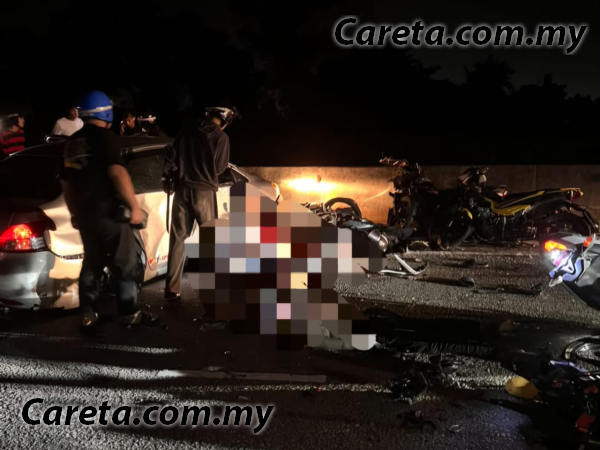
The fatal accident occurred on 19 September 2026, at 3:35 a.m. on Jalan Jelapang–Ampang in Ipoh. Police initial investigations report that a convoy of motorcyclists was travelling at high speed from Ipoh when they lost control and collided with a Toyota Vios. A second group of riders, unable to brake in time, then hit the stationary vehicles.
Three male riders aged 19 to 20 were killed at the scene, and nine others aged 19 to 25 sustained injuries. All involved persons have been identified; police are still investigating the cause, confirming vehicle ownership, and have taken statements from all witnesses except one 19-year-old who remains in the intensive care unit of Hospital Raja Permaisuri Bainun. The road is a known hotspot for illegal street racing and “samseng jalanan” (road gang) activities.
The Ipoh accident, which claimed three lives, was reportedly preceded by high-speed riding in a convoy, leading to multiple collisions involving two separate groups of motorcyclists and a car.
What Enforcement Actions Are Police Taking Against Illegal Racing?
From January to 19 September 2026, the Ipoh District Traffic Investigation and Enforcement Division conducted 64 operations targeting road gangs and illegal racing. Those operations resulted in 11 arrests under Section 42(1) of the Road Transport Act 1987 (reckless driving) and 41 vehicle seizures under Section 64(1) of the same act.
Police noted that after an early-morning operation ended at 3 a.m., the group reconvened and the accident occurred at 3:35 a.m. – just 35 minutes after the enforcement window closed. This highlights the recurring challenge of illegal racing in that area. The authorities continue to collect evidence, including statements from the surviving riders and the driver of the involved Toyota Vios.
Between January and 19 September 2026, Ipoh police carried out 64 anti-racing operations, arrested 11 individuals, and seized 41 vehicles for illegal racing offences.
How Does This Benefit Compare for Malaysian Families?
For a typical Malaysian family relying on a single wage earner aged 19–20, a PERKESO dependants' pension of RM800–RM1,000 per month can cover basic necessities such as rent for an apartment unit, utility bills (TNB, water), and groceries. The RM3,000 funeral management benefit also covers standard burial costs in Malaysia, which average between RM2,800 and RM4,000 for a basic Muslim funeral in urban areas.
This payout structure is designed to replace roughly 30–40% of the deceased worker's average wage, depending on contributions. For young workers earning around RM1,500–RM2,000 monthly, the RM945 figure aligns with this percentage. The scheme is particularly relevant for families in compact urban dwellings (e.g., KL condos) who may not have other insurance coverage.
For a Malaysian family earning RM1,500–RM2,000 per month, the RM945 PERKESO pension replaces approximately 40% of lost income, enabling continued payment of rent and basic bills.
Common Questions
Does Skim Lindung 24 Jam cover accidents that happen outside working hours?
Yes. The scheme explicitly covers accidents that occur outside of work hours, including weekends and public holidays. PERKESO confirmed this protection for both Ipoh victims, whose fatal motorcycle accident happened at 3:35 a.m. on a Saturday.
How much is the Funeral Management Benefit under PERKESO?
PERKESO pays a one-time Funeral Management Benefit of RM3,000 per eligible deceased worker. This amount is paid directly to the family or funeral service provider and is separate from the monthly dependants' pension.
Who receives the Dependants' Benefit from PERKESO after a worker's death?
Parents receive lifelong payments, while siblings receive payments until they turn 21 or complete a first degree, whichever comes first. All recipients must be Malaysian citizens or permanent residents and must have been financially dependent on the deceased.
Sources and Methodology
This article is based on the original report “Keluarga Dua Mangsa Nahas Ipoh Terima Faedah PERKESO Lebih RM275,000” by Qalif Latif, published by Careta on 21 September 2026, and archived at careta.my. The report draws from Bernama and Malaysia Gazette. All figures are in Malaysian Ringgit (RM). No currency conversion was applied.
Direct quotations are attributed as they appear in the original source. Information about police operations and legal citations (Sections 42(1) and 64(1) of the Road Transport Act 1987) is sourced from Malaysia Gazette via Careta. PERKESO's statements on eligibility and benefit amounts are as reported by Bernama.
This article was last updated on 19 February 2025. Information specific to Malaysia was verified against the Careta article and the Employees’ Social Security Act 1969.