CEER Exobot Saudi EV Hits 0-100 in 2.1s with 1,111 HP
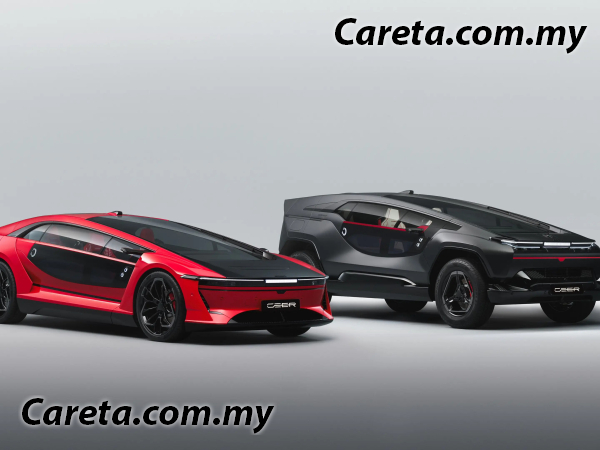
The CEER EXOBOT is the flagship battery-electric vehicle (EV) line from CEER, the first national automotive brand of Saudi Arabia. It consists of two models — the EXOBOT Sedan and EXOBOT SUV — both powered by a tri-motor, all-wheel-drive (AWD) electric drivetrain, with a top configuration producing 1,111 HP and 1,500 Nm. CEER will assemble the EXOBOT at its CEER Manufacturing Complex in King Abdullah Economic City. For Malaysian consumers, the EXOBOT currently has no confirmed local distributor, warranty provider, or official price, so an RM conversion is not available.
According to Careta, the EXOBOT is designed to demonstrate that Saudi Arabia is "not just a market for luxury and high-performance cars, but capable of producing its own cars." The vehicle line is the first step in CEER's plan to offer seven models by 2030, including mid-segment and compact vehicles with multiple powertrain options.
Key Facts
| Attribute | Value |
|---|---|
| Brand | CEER (Saudi Arabia's first national automotive brand) |
| Models | EXOBOT Sedan and EXOBOT SUV |
| Category | Flagship battery-electric vehicle (EV) |
| Maximum output | 1,111 HP / 1,500 Nm (top version) |
| 0–100 km/h, Sedan | 2.1 seconds (top version) |
| 0–100 km/h, SUV | 2.4 seconds (top version) |
| Top speed, Sedan | 250 km/h |
| Top speed, SUV | 210 km/h |
| First Edition output | 850 HP / 1,000 Nm |
| First Edition 0–100 km/h | 2.6 s (Sedan), 2.9 s (SUV) |
| Battery (First Edition) | 112 kWh NCM, 800V architecture |
| Stated range (First Edition) | Up to 670 km (Sedan), up to 560 km (SUV) |
| Charging time (10–80%) | Under 30 minutes |
| Dimensions, Sedan | 5.26 m x 2.1 m x 1.43 m (L x W x H) |
| Dimensions, SUV | 5.02 m x 2.1 m x 1.69 m (L x W x H) |
| Windscreen | 2.4 m long, 15-degree angle, heat-reducing layer |
| Doors | Shahin Wing Doors, approximately 3 m long |
| Interior display | 48-inch 8K curved Digital Horizon Display |
| Production start | January 2027 |
| First deliveries | Around March 2027 |
| Price | Not announced — RM conversion unavailable |
| Malaysian availability | No distributor, pricing, or warranty confirmed |
What Is the CEER EXOBOT and Who Makes It?
The CEER EXOBOT is the first vehicle line produced by CEER, the national automotive brand of Saudi Arabia, unveiled as a flagship EV in Sedan and SUV body styles. CEER plans seven models by 2030, with the EXOBOT manufactured at the CEER Manufacturing Complex in King Abdullah Economic City.
CEER's design language for the EXOBOT is drawn from regional heritage. As Careta reports:
"Its design language is inspired by the ancient architecture of Hegra, while several other elements also carry the Saudi Arabian identity."
— Firdaus Razani, Careta (22 September 2026)
The headlights use 32 lighting elements, referencing 1932, the year Saudi Arabia was unified as a kingdom. The cabin includes a yoke-style steering wheel, electrochromic door glass that turns from clear to opaque at the touch of a button, and a 48-inch 8K curved Digital Horizon Display. Physical controls remain for gear selection, air conditioning, and sound level.
The CEER EXOBOT is manufactured at the CEER Manufacturing Complex in King Abdullah Economic City, Saudi Arabia, with series production scheduled to begin in January 2027.
How Fast Is the CEER EXOBOT?
In its most powerful configuration, the EXOBOT Sedan accelerates from 0-100 km/h in 2.1 seconds and reaches a top speed of 250 km/h, while the EXOBOT SUV completes the same sprint in 2.4 seconds and tops out at 210 km/h. The First Edition variants produce 850 HP and 1,000 Nm, with 0-100 km/h times of 2.6 seconds for the Sedan and 2.9 seconds for the SUV.
Both models use a tri-motor electric configuration with all-wheel drive, continuous torque vectoring, and an active chassis system. The EXOBOT also uses steer-by-wire technology, reducing steering input from approximately 400 degrees to only 160 degrees, and adds rear-wheel steering to reduce the turning radius at low speeds and improve stability at high speed.
With 1,111 HP and 1,500 Nm, the CEER EXOBOT Sedan accelerates from 0-100 km/h in 2.1 seconds and reaches a governed top speed of 250 km/h.
What Is the Driving Range and Charging Performance?
The First Edition EXOBOT uses a 112 kWh NCM (nickel-cobalt-manganese) battery with an 800V electrical architecture. CEER states a range of up to 670 km for the Sedan and up to 560 km for the SUV, while charging from 10 to 80 percent takes less than 30 minutes.
The First Edition is distinguished by red brake calipers, a Black Color Pack, black and red Nappa leather seats, and a numbered plaque that corresponds to each vehicle's VIN. The 800V architecture enables high-speed DC charging, although the source does not specify the connector type, charge port location, or onboard AC charger output.
The CEER EXOBOT First Edition sedan delivers up to 670 km of stated range and can recharge from 10 to 80 percent in less than 30 minutes on its 800V architecture.
How Does the CEER EXOBOT Manage Heat?
CEER developed the Halo Cooling system specifically for extreme heat, claiming it reduces cabin temperature from 65 degrees Celsius to 32 degrees Celsius within 10 minutes. The system works alongside a heat-reducing windscreen layer, separate front and rear air-conditioning zones, and an aerodynamic roof design to limit heat build-up.
This thermal management focus matters for Malaysian users because the country's tropical climate produces cabin temperatures that can exceed 60 degrees Celsius for vehicles parked in direct sunlight. The source does not provide independent third-party verification of CEER's cooling claims; the figures are the manufacturer's stated performance.
CEER claims the EXOBOT's Halo Cooling system reduces cabin temperature from 65 degrees Celsius to 32 degrees Celsius in 10 minutes, a metric directly relevant to Malaysian tropical conditions.
Who Is This For in Malaysia?
The CEER EXOBOT is not currently sold in Malaysia, and the source confirms CEER's immediate focus is on Saudi Arabia and the surrounding Gulf markets. Malaysian buyers interested in high-performance EVs should treat the EXOBOT as a benchmark rather than an available purchase, and no RM pricing can be provided until CEER announces a regional launch.
The source specifies production begins January 2027, with deliveries from approximately March 2027. Malaysia's public DC fast-charging network predominantly uses CCS2 connectors, and the EXOBOT's charging port standard has not been confirmed in the published information. Buyers in Malaysia would also need to consider local 240V supply compatibility for any future home AC charging, which remains unconfirmed.
As of September 2026, the CEER EXOBOT is not confirmed for the Malaysian market, has no official local distributor, and no RM price has been announced by CEER.
Common Questions
Will the CEER EXOBOT be sold in Malaysia?
The source gives no confirmation of Malaysian availability. CEER states its current focus is on Saudi Arabia and surrounding Gulf markets. Production begins January 2027, with first deliveries around March 2027, but no timeline exists for ASEAN or Malaysian launch, including for Malaysia's nearest comparable market, Singapore.
Can the CEER EXOBOT be charged in Malaysia?
The source does not specify the EXOBOT's charging connector type, charge port location, or AC charging capacity. It states the 800V architecture allows 10 to 80 percent charging in under 30 minutes. Malaysia's public networks typically use CCS2 connectors, but compatibility with the EXOBOT is not confirmed in published materials.
How does the CEER EXOBOT's range compare to EVs available in Malaysia?
CEER states up to 670 km range for the EXOBOT Sedan and up to 560 km for the SUV. Independent range testing in Malaysian climate and traffic conditions has not been conducted or published. Real-world performance in Malaysia's high temperatures and highway use may differ from the stated figures.
Sources and Methodology
This article is based on a single primary source: Firdaus Razani, "CEER EXOBOT – EV Buatan Arab Saudi Dengan 1,111 HP, 0-100 Kmj 2.1 Saat!" published by Careta (careta.my) on 22 September 2026. The source was translated from Malay to English using British spelling conventions.
- Currency conversion: No price was disclosed in the source, so no Ringgit Malaysia conversion is provided.
- Unit translation: All metric units (km/h, metres, kilogrammes implied by the source) are preserved as originally published; miles per hour equivalents are not given.
- Localisation: Malaysian context regarding tropical climate, charging infrastructure, and 240V household supply was added to assist reader comprehension; no Malaysian-specific data appears in the original source.
- Direct quotations: The blockquote in the design section is a translation of the original Malay sentence about Hegra architectural inspiration; the translated quote is attributed to the original author and publication.
This article was last updated on 22 September 2026. Information specific to Malaysia was verified against the primary source; however, the source does not contain Malaysian-specific data, and no official CEER Malaysian announcement exists as of the last review date.