Guide to MAS Car Loan Restrictions in Singapore 2026
Buying a car in Singapore? Learn how 2026 MAS car loan restrictions, OMV tiers, and loan tenure limits affect your down payment and total borrowing power.
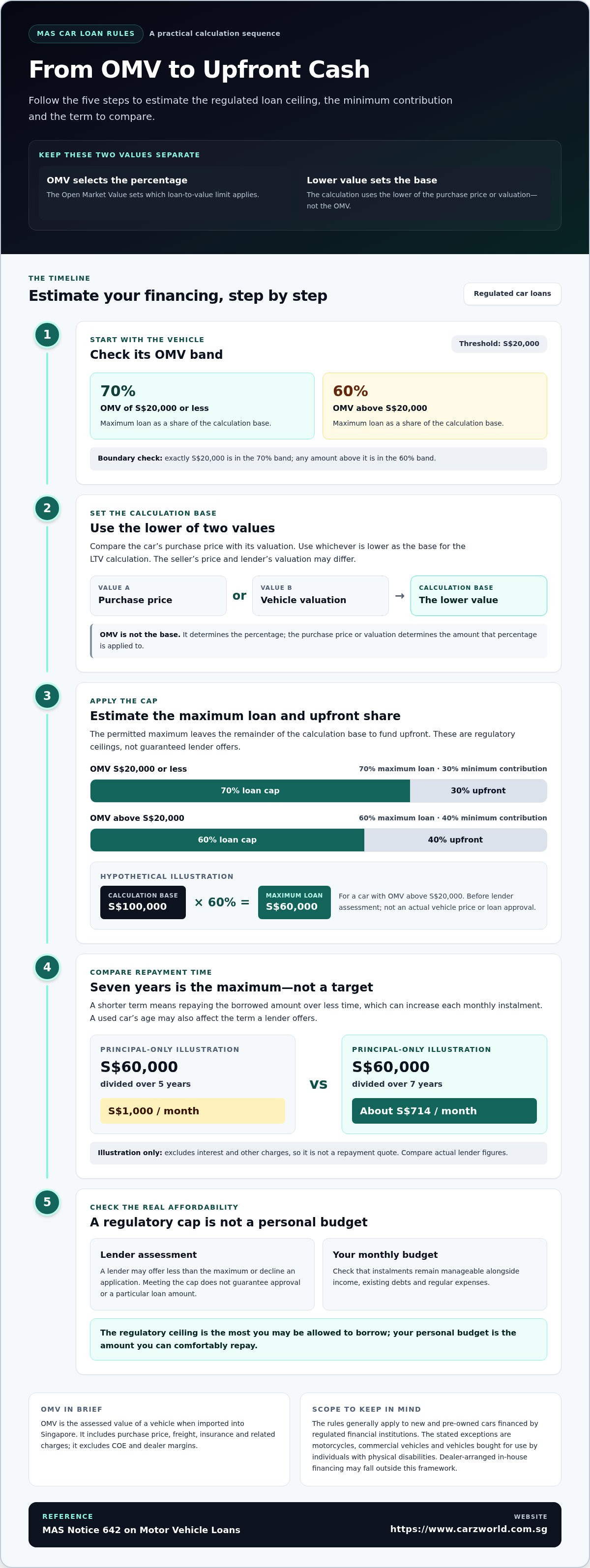
The Monetary Authority of Singapore (MAS) car loan restrictions are statutory credit limits governed by MAS Notice 642 on Motor Vehicle Loans, designed to regulate consumer borrowing across Singapore's automotive sector. Issued by the central bank and financial regulator, the framework applies to motor vehicle financing extended by regulated financial institutions. These rules solve the challenge of debt over-leveraging for prospective car buyers navigating high vehicle acquisition costs by setting strict borrowing ceilings based on a vehicle's Open Market Value (OMV). Applicable across both new and pre-owned vehicle purchases, the guidelines dictate upfront cash down payments and repayment tenures alongside the Total Debt Servicing Ratio (TDSR) framework.
Key Facts
| Attribute | Value |
|---|---|
| Regulatory Authority | Monetary Authority of Singapore (MAS) |
| Governing Regulation | MAS Notice 642 on Motor Vehicle Loans |
| LTV Cap for OMV S$20,000 or Less | 70% of lower of purchase price or valuation |
| LTV Cap for OMV Above S$20,000 | 60% of lower of purchase price or valuation |
| Minimum Upfront Cash Deposit (OMV ≤ S$20,000) | 30% of calculation base |
| Minimum Upfront Cash Deposit (OMV > S$20,000) | 40% of calculation base |
| Maximum Regulated Loan Tenure | 7 years (84 months) |
| Total Debt Servicing Ratio (TDSR) Ceiling | 55% of gross monthly income |
| Applicable Vehicle Categories | Regulated passenger cars (new and pre-owned) |
| Exempt Vehicle Categories | Motorcycles, commercial vehicles, vehicles for persons with physical disabilities |
How Do OMV Tiers Determine Singapore Car Loan Limits?
Under MAS regulations, a vehicle's Open Market Value (OMV) directly dictates the statutory Loan-to-Value (LTV) limit. For vehicles with an OMV of S$20,000 or less, regulated lenders may finance up to 70% of the lower of the purchase price or valuation. For vehicles exceeding an OMV of S$20,000, the borrowing ceiling is strictly capped at 60%.
The calculation base is strictly the lower of the purchase price or valuation, rather than the OMV itself. OMV represents the assessed value of a vehicle upon importation into Singapore, comprising purchase price, freight, insurance, and handling charges, while excluding Certificate of Entitlement (COE) premiums and dealer margins. According to the MAS Rules for Motor Vehicle Loans explainer, financial institutions must apply these caps prior to internal credit scoring.
For cars with an OMV of S$20,000 or less, the maximum loan is 70% of the calculation base. For cars with a higher OMV, the limit is 60%. The maximum loan tenure is seven years, though a used car’s age may affect the term a lender offers.
MAS Notice 642 on Motor Vehicle Loans / Carz World Singapore
For an imported vehicle with an OMV exceeding S$20,000 where both the valuation and purchase price stand at S$100,000 (~RM328,000), the maximum allowable loan is S$60,000, mandating an upfront cash outlay of at least S$40,000. A vehicle with an Open Market Value exceeding S$20,000 requires a minimum upfront cash down payment of 40% under Singapore regulatory limits.
How Does Loan Tenure Affect Monthly Car Instalments in Singapore?
The maximum statutory repayment tenure for motor vehicle loans from regulated financial institutions in Singapore is seven years (84 months). While seven years represents the regulatory ceiling, actual tenures offered by lenders may be shorter depending on borrower credit assessment, internal bank risk profiles, and the specific age of a pre-owned vehicle.
A shorter repayment tenure compresses the principal repayment schedule into fewer monthly cycles, resulting in higher monthly cash commitments despite reducing total interest costs over the borrowing life cycle. Based on a principal-only benchmark of S$60,000, an amortisation schedule spanning five years requires S$1,000 per month, whereas extending repayment over the maximum seven-year tenure lowers the principal obligation to approximately S$714 per month.
Borrowers must balance loan tenure choices against the Total Debt Servicing Ratio (TDSR) threshold, which caps total monthly debt obligations at 55% of gross monthly income. The maximum permitted car loan tenure under MAS regulations is seven years, but lenders may restrict pre-owned vehicle terms based on vehicle age.
How Do MAS Financing Rules Apply to Pre-Owned Cars Versus New Cars?
Pre-owned cars are subject to the identical MAS Loan-to-Value thresholds and maximum seven-year tenure caps as brand-new vehicles. A pre-owned vehicle's borrowing tier is determined entirely by its historical baseline OMV rather than its depreciated resale price, market depreciation rate, or prevailing Certificate of Entitlement (COE) supply quota.
Prospective used car buyers cannot assume an older vehicle defaults to the 70% financing tier simply due to a depreciated ticket price. Lenders independently assess pre-owned vehicle applications, factoring in the vehicle's remaining COE duration alongside mechanical age. Furthermore, dealer-arranged in-house financing schemes operate outside the MAS-regulated financial-institution framework, meaning non-bank lending terms, deposit requirements, and interest structures differ substantially from standard MAS rules.
Prospective buyers comparing dealership inventory across platforms like Carz World must account for non-financed operational expenditures, including road tax surcharges on older vehicles, comprehensive insurance premiums, and maintenance overheads. Pre-owned vehicle loan ceilings in Singapore follow original vehicle Open Market Value bands rather than second-hand resale valuations.
Who Is This For in Singapore?
MAS car loan restrictions directly impact Singaporean private vehicle buyers navigating the substantial capital requirements of Certificate of Entitlement (COE) Category A and Category B passenger cars. The rules are particularly critical for working professionals, Housing & Development Board (HDB) upgraders, and private condominium residents planning personal transport budgets within strict regulatory borrowing caps.
Because the mandated 30% to 40% upfront deposit must be funded entirely in cash and cannot be financed through supplementary credit lines, buyers must preserve substantial liquidity. This liquidity requirement operates alongside mandatory ancillary vehicle costs, including Land Transport Authority (LTA) registration charges, Electronic Road Pricing (ERP 2.0) on-board unit installations, Vehicular Emissions Scheme (VES) surcharges or rebates, and cross-border requirements such as Vehicle Entry Permits (VEP) for travel across the Johor-Singapore Causeway and Tuas Second Link.
Prospective purchasers must evaluate upfront capital liquidity alongside ongoing monthly affordability before committing to sales agreements at authorized dealerships or parallel importers. Singapore car buyers must fund the entire statutory deposit of 30% or 40% using cash without secondary borrowing facilities.
Common Questions
What is the maximum car loan percentage allowed in Singapore?
Under MAS regulations, regulated lenders can finance up to 70% of the lower of the purchase price or valuation for vehicles with an OMV of S$20,000 or less, and up to 60% for vehicles with an OMV exceeding S$20,000.
Can a buyer obtain a 100% car loan from a regulated Singapore bank?
No. Regulated financial institutions cannot exceed MAS LTV caps of 60% or 70%, requiring cash down payments of at least 30% to 40%. Zero-deposit arrangements fall exclusively under unregulated in-house dealer financing schemes outside MAS rules.
How does vehicle age impact pre-owned car loan tenure in Singapore?
Although the statutory maximum tenure is seven years, regulated lenders adjust available financing terms downward based on a used car's age and remaining Certificate of Entitlement (COE) validity, often offering shorter tenures than the regulatory cap.
Sources and Methodology
This reference guide synthesises statutory guidelines from MAS Notice 642 on Motor Vehicle Loans, the Monetary Authority of Singapore explainer on Rules for Motor Vehicle Loans, and vehicle financing data from Carz World Singapore. All monetary figures are stated in Singapore Dollars (SGD / S$) with selective cross-border Malaysian Ringgit (~RM) equivalents provided for regional transit context. This article was last updated on 12 October 2026. Information specific to Singapore was verified against the Monetary Authority of Singapore regulatory notices and Land Transport Authority vehicle ownership standards.
Related coverage
- COE Renewal 5 Years vs 10 Years Pros and Cons Guide
- Singapore Tightens Vehicle Entry Permit Rules From Nov 2
- Motorcycle Ownership Changing Hands Without JPJ Records
- Honda Showcases New CB250SS 250cc Scrambler Concept
- Johor JPJ Demands Answers Over Errant P-Hailing Riders
- Singapore Motorcyclists Face RM38,000 COE Cost to Ride