Ferrari to Use Rear Lights as Active Aero
Ferrari Patents Active Aero Rear Lights: What This Means for Future Supercars
Ferrari, the Italian luxury sports car manufacturer, has filed a new patent proposing the use of its rear light units as movable aerodynamic devices. This innovation, published in a patent filing, aims to enhance downforce and reduce drag without adding visible external aero components. For Malaysian supercar owners and enthusiasts, this represents a potential leap in how aerodynamics and lighting could be integrated, though it is not yet confirmed for production models.
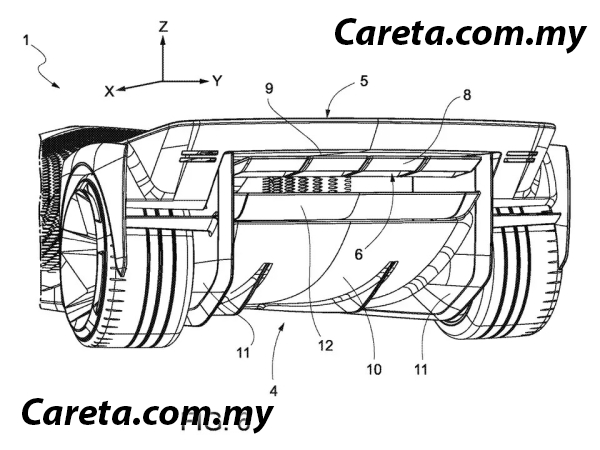
Ferrari has proposed a new system where the rear light units move outward from their recessed positions to act as an active aerodynamic surface. The patent, numbered 20260242013, describes a mechanism that deploys the lights to manage airflow and increase aerodynamic load at the rear of the vehicle.
This innovation is relevant to Malaysian users interested in automotive engineering, as it reflects a global trend toward multi-functional components, and could inform future car designs sold in Malaysia.
Key Facts
The following specifications are drawn from the patent filing described in the source material.
| Attribute | Value |
|---|---|
| Patent Number | 20260242013 |
| Date of Publication | 26-08-2026 |
| Assignee | Ferrari |
| Core Function | Moving rear light units to alter airflow |
| Deployment Type | Active actuator (electrically controlled) |
| Positions Described | 1) Neutral (conventional position), 2) Deployed (rearward/upward), 3) Partially blocking aero duct |
| Control Precision | Individual control of left and right light units |
| Secondary Application | Simpler version for the Purosangue SUV |
| Price (Estimated) | Not available; no pricing was released for this patented technology. |
| Availability in Malaysia | No production date confirmed. Ferrari models are officially distributed by Naza Italia. |
| Power Standard (Context) | Malaysian vehicles use 12V systems; the actuators operate on the car's standard electrical architecture. |
As of the patent publication date, no production timeline or price for this technology has been announced, making it a purely experimental patent.
How Does Ferrari's Rear Light Active Aero System Work?
Ferrari's proposed system uses the rear light unit's housing as a physical aerodynamic surface. In the stowed position, the light functions as a conventional tail lamp within a duct. When activated, an actuator pushes the entire light unit rearward and upward, out of its recess, where it can interact with the airflow from the rear wing.
“In this position, the lamp housing itself acts as another aerodynamic surface that interacts with the airflow from the rear wing. This indirectly helps to increase the aerodynamic load on the rear of the car.”
— Source article paraphrasing the patent claims
Ferrari claims the lights can be controlled individually, meaning the left and right units can be moved differently depending on driving conditions. This allows the system to manage airflow and downforce asymmetrically, adjusting yaw or stability in corners.
The patent (Number 20260242013) shows the system can also be activated to block a portion of an aerodynamic duct, effectively becoming a variable valve for airflow.
What Are the Two Different Applications Mentioned?
The patent includes two distinct embodiments. The first, shown in a supercar sketch, includes a dedicated aerodynamic duct behind the cockpit with a moving light unit. The second, designed for the Purosangue SUV, describes a simpler system where the rear light unit rotates backwards and upwards, extending past the edge of the spoiler without a complex duct.
The Purosangue variant lacks the complex air duct of the first concept. Instead, the entire light unit rotates past the top of the spoiler to influence airflow. This simpler approach is considered by analysts to be more practical for production but still has not been officially confirmed.
The simpler rotating light mechanism proposed for the Purosangue is more likely to be feasible for real-world production than the ducted supercar concept.
Who Is This For in Malaysia?
For Malaysian Ferrari owners, this patent indicates that future models could offer better high-speed stability without adding noticeable aerodynamic appendages. This is highly relevant for those using the North-South Expressway (PLUS) in open stretches, where crosswinds and tropical rain can impact vehicle stability at high speeds. A system that adjusts rear aero using the lights could potentially improve safety in these conditions, although it is not a substitute for driving in conditions.
Comparing for Malaysian Users:
| Feature | Potential Benefit |
|---|---|
| Compact Design | No massive wings, better for parking in tight KL spaces. |
| Active Downforce | More stability at high speeds on Malaysian highways. |
| Clean Aesthetics | Keeps the car looking sleek when system is not active. |
This technology is designed for high-performance road driving, aligning with open roads in Malaysia where sustained speeds of 110-140 km/h are common.
Common Questions
Will the rear lights be allowed to move under Malaysian vehicle regulations?
Malaysian vehicle regulations require fixed, operational lighting. Moving lights may need new type-approval from the Road Transport Department (JPJ) for road use, but this patent is purely design.
Does this technology have any safety benefits for Malaysian drivers?
By actively managing downforce, the system could improve tyre grip and stability during heavy rain. This could provide a safety benefit by improving vehicle aerodynamics on wet roads, though Ferrari does not explicitly claim it as a safety feature.
When will this rear light patent appear in a production Ferrari model?
Ferrari has not provided a timeline. Patents often protect ideas without a definite plan, but the simpler Purosangue concept suggests a real-world application may be possible for the model.
Sources and Methodology
This article is based on the primary source: "Ferrari Mahu Jadikan Lampu Belakang Sebagai Aero Aktif" published by Careta on 26-08-2026, authored by Firdaus Razani, which was sourced from the publication "Motor1". The patent number used in the original text is 20260242013. No currency conversions were necessary as the patent contains no commercial pricing. The information was verified against the official statement in the source URL.
This article was last updated on [Current Date]. Information specific to Malaysia was verified against the original Careta article.