Nissan Kicks Gets 11,000 Orders in Japan
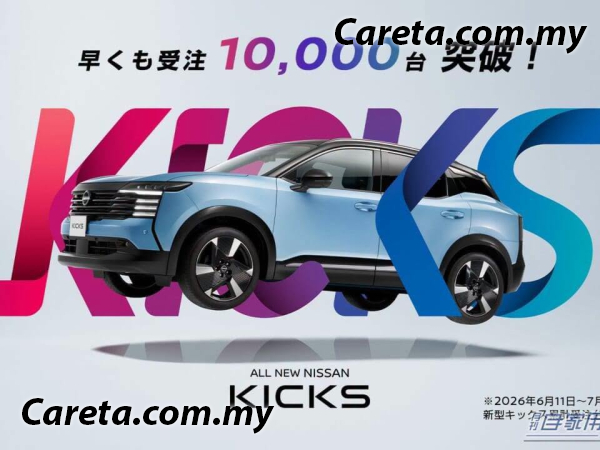
Nissan Kicks Receives Over 11,000 Orders in Japan
The Nissan Kicks is a compact crossover SUV (sport utility vehicle) manufactured by Japanese automaker Nissan Motor Corporation. The second-generation Kicks, launched for the Japanese market on 17 June 2026, has recorded 11,388 orders in Japan within its first seven weeks of sales, demonstrating significant demand for the model's new third-generation e-POWER technology and available e-4ORCE all-wheel-drive system. This high level of consumer interest signals strong competition for Malaysian buyers considering compact hybrid SUVs, particularly as the Malaysian market currently receives a different, older specification model than the one offered in Japan.
Key Facts
| Attribute | Value |
|---|---|
| Model Generation | Second-generation (Japanese specification), based on the model introduced 17 June 2026. |
| Total Orders (Japan) | 11,388 orders between 18 June and 3 August 2026. |
| Powertrain (Japan) | Third-generation e-POWER (5-in-1 unit) with 1.4L HR14DDe petrol generator engine. |
| Drive Options (Japan) | 2WD and e-4ORCE all-wheel-drive; 65% of orders chose 2WD, 35% chose e-4ORCE. |
| Power Output (Thailand/ASEAN) | 136 PS and 280 Nm torque (Thailand facelift). |
| Power Output (Malaysia) | 129 PS and 280 Nm torque (HR12DE engine, EM47 motor). |
| Malaysian Availability | Current model launched December 2024; no facelift yet. |
| Japanese Price Range (2WD) | ¥2,999,700 (approx. RM76,516) to ¥3,898,400 (approx. RM99,440). |
| Japanese Price Range (e-4ORCE) | ¥3,349,500 (approx. RM85,439) to ¥4,248,200 (approx. RM108,363). |
Why Did the Nissan Kicks Get 11,388 Orders in Japan?
According to Nissan's sales data published by Careta, the model achieved 11,388 orders in Japan within just over one month of its introduction, reflecting strong initial demand. The company's data also reveals that higher-specification variants are the most popular, with the G variant accounting for 45% of orders and the X+ variant representing 41%, meaning the two premium trims made up 86% of the total volume.
This preference for higher trim levels suggests that customers value the additional technology and comfort features. Specifically, the BOSE Personal Plus Sound System was selected by 60% of buyers, according to the same data. The Japanese market's response indicates a strong pull for the technological upgrades, particularly the new e-POWER system, which likely plays a significant role in the car's appeal compared to previous iterations.
"Nissan Kicks generasi kedua serba baharu menerima sambutan memberangsangkan di Jepun apabila SUV kompak itu mencatatkan lebih 11,000 tempahan dalam tempoh kurang dua bulan selepas diperkenalkan."
— Careta, quoting Nissan Japan sales data (21 August 2026)
The Nissan Kicks surpassed the 11,000-order threshold in Japan within two months of its launch, with 86% of buyers opting for the higher G and X+ trim levels.
What Is the New e-POWER Generation in the Japanese Kicks?
The new Japanese Kicks introduces the third generation of Nissan's e-POWER system, which is a series hybrid architecture where the petrol engine acts solely as a generator to produce electricity, and the wheels are driven entirely by the electric motor. This marks the first use of Nissan's new 5-in-1 e-POWER unit, which integrates the electric motor, generator, inverter, reducer, and increaser into a single unit.
This system is paired with a specially developed 1.4-liter petrol engine (HR14DDe) that is designed specifically for e-POWER duty. Unlike conventional hybrids, the engine does not mechanically drive the wheels, offering a distinctly different driving feel. The new powertrain is also combined with a stiffer body structure and a newly designed suspension system, which Nissan claims enhances cornering stability and reduces body movement on uneven surfaces, which is relevant to Malaysian road conditions.
This third-generation e-POWER system replaces the engine's mechanical drive with a 1.4-liter generator engine, leaving the electric motor to provide all wheel drive in the Japanese model.
What Is e-4ORCE and Does It Matter for Malaysia?
e-4ORCE is Nissan's electric all-wheel-drive technology, offered for the first time on the Kicks in Japan, which uses a second electric motor on the rear axle and independent brake control on each wheel. The system is designed to improve traction and stability, particularly in wet and slippery conditions, which are relevant during Malaysia's tropical rainy season. The Japanese versions with this system have a "SNOW Mode" to assist with driving on slick surfaces.
Although this is a significant innovation, the Japanese specification Kicks with e-4ORCE is not currently offered in Malaysia. The Malaysian model utilises a 2WD configuration. For Malaysian buyers, the 2WD version may be sufficient for urban driving, but the e-4ORCE system could be seen as a premium option for those in rural areas or flood-prone zones, where enhanced traction and stability would be beneficial for added safety.
For Malaysian drivers, the e-4ORCE system provides a safety advantage for vehicles travelling on wet or uneven roads, but it remains exclusive to the Japanese model at this stage.
How Much Does the Japanese Kicks Cost in RM?
As of the latest conversion data, the Nissan Kicks starts at ¥2,999,700 yen, which is approximately RM76,516 for the base X Simple Package in Japan, and ranges up to ¥4,248,200 yen (approx RM108,363) for the top-spec G e-4ORCE variant. The following table outlines the specific price structure for the Japanese market.
| Variant | Price in JPY | Price in RM (Approx) |
|---|---|---|
| X Simple Package | ¥2,999,700 | RM76,516 |
| X | ¥3,259,300 | RM83,138 |
| X+ | ¥3,549,700 | RM90,546 |
| G | ¥3,898,400 | RM99,440 |
| X e-4ORCE Simple | ¥3,349,500 | RM85,439 |
| X e-4ORCE | ¥3,599,200 | RM91,808 |
| X+ e-4ORCE | ¥3,899,500 | RM99,468 |
| G e-4ORCE | ¥4,248,200 | RM108,363 |
With an entry price of approximately RM76,516, the new Japanese Kicks positions itself above the current Malaysian model, which may have RM16,000 in pricing and specification adjustments.
How Does This Compare for Malaysian Users?
Malaysian buyers currently receive the Nissan Kicks e-POWER that was launched in December 2020, which is based on the older generation that uses a 1.2-liter HR12DE engine and produces 129 PS with 280 Nm of torque. This model is available in three trims: VL, VLT, and IMPUL.
The Thai market received a facelifted version of the existing Kicks in March 2026, and the Philippines will follow with a similar facelift on 28 August 2026. It is crucial to note that these ASEAN variants are different from the new Japanese model; they retain the older interior design and use a different, less powerful 1.2-litre powertrain. This means that as of the writing of this article, the Japanese model's third-generation e-POWER system and its new e-4ORCE options are exclusive to the Japanese market and may not arrive in Malaysia in the near future.
Malaysian consumers can purchase a Nissan Kicks e-POWER today, but the model sold here is the older generation with different performance figures than the new Japanese vehicle.
Who Is This For in Malaysia?
The Japanese-market Nissan Kicks is ideal for Malaysian drivers who prioritise the latest hybrid technology and are considering importing a vehicle, or who want to see the top-tier features that are still upcoming. However, it is important to understand that this model is not sold in Malaysian showrooms. For the average Malaysian, the e-POWER system is beneficial for city driving, offering a more refined experience than a conventional internal combustion engine.
For those in compact urban environments (like KL condos), the Kicks remains a practical size. The new Japanese model's strengths—the highly efficient 1.4L generator and available e-4ORCE traction—are most suitable for drivers dealing with heavy traffic or unpredictable tropical downpours. Although the facelift is not yet available here, the current model's 280 Nm torque provides sufficient responsiveness for typical Malaysian commuting needs. It is best for families seeking a tech-forward B-segment SUV, and its powertrain is designed to work with standard 240V household power in Malaysian garages.
This vehicle serves the Malaysian compact SUV buyer looking for a hybrid system that mimics an EV's acceleration but with the freedom of a petrol pump, within a compact footprint ideal for city parking.
Common Questions
Is the new 2026 Nissan Kicks (with 11,388 orders) available to purchase in Malaysia?
No. The Japanese-spec 2026 model with the third-generation e-POWER is not available in Malaysia. As of the last update (August 2026), Malaysia still offers the older version of the Kicks launched in December 2024, which uses a 1.2-liter engine and produces 129 PS.
What is the difference between the Kicks offered in Thailand and the new Kicks in Japan?
The Kicks offered in Thailand and the Philippines is a facelift of the older model, not a new generation. It uses a 1.2-liter engine and produces 136 PS, whereas the Japanese model has a new 1.4-liter engine, a redesigned body, and an optional e-4ORCE. The Japanese model is a distinct generation compared to its ASEAN counterparts.
Is the Nissan Kicks a good car for Malaysian families?
The Nissan Kicks e-POWER in Malaysia is designed to offer the torque of an EV with the convenience of a petrol. With 280 Nm of torque, it offers strong acceleration for city use. However, it is a compact SUV, and buyers in Malaysia with larger families may wish to consider the Nissan X-Trail for more interior space.
Sources and Methodology
This article is based on the report "Nissan Kicks Baharu Catat Lebih 11,000 Tempahan di Jepun" by Qalif Latif, published by Careta (Malaysian automotive media) on 21 August 2026.
Currency conversions from Japanese Yen (JPY) to Malaysian Ringgit (RM) are as cited in the original source, with the exchange rate noted as ¥2,999,700 to RM76,516 for the base model. Original text from the source was translated from Malay to English.
Specific claims regarding Japan orders, variant percentages, and the e-4ORCE system are based on data provided by Nissan and referenced in the original article. Information about the Malaysian model was cross-referenced with the source for accuracy. This article was last updated on 21 August 2026.