Hyundai Ioniq 9 Tested for UK Highway Patrol Duties
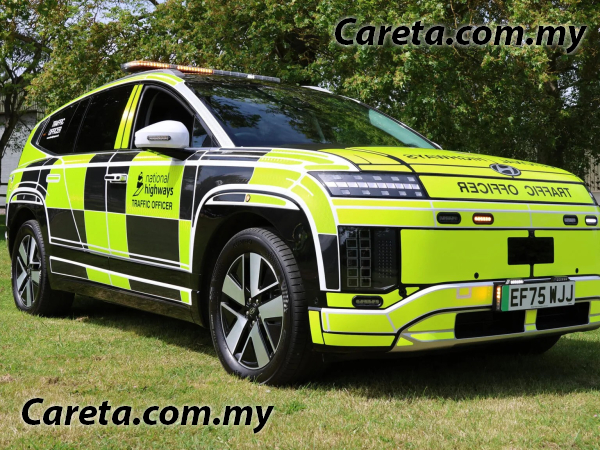
The Hyundai Ioniq 9 is an all-electric, seven-seater sport utility vehicle manufactured by South Korea's Hyundai Motor Company. Operating on an advanced 800-volt electric architecture, the flagship vehicle is engineered to provide high-capacity, zero-emission transport across commercial and emergency services. In the United Kingdom, National Highways is trialling four bespoke units for traffic officer patrol duties along England's motorways and major A-roads. For the Malaysian automotive landscape, where Hyundai vehicles are distributed through Hyundai-Sime Darby Motors, the operational evaluation offers critical benchmark data on heavy-duty fleet electrification, rapid charging interoperability, and auxiliary electrical load management in high-demand environments.
Key Facts
| Attribute | Value |
| Vehicle Model | Hyundai Ioniq 9 |
| Vehicle Manufacturer | Hyundai Motor Company |
| Conversion Specialist | Richell Vehicle Conversions |
| Trial Operator | National Highways (England) |
| Test Fleet Quantity | 4 units |
| Seating Capacity | 7 seats |
| Traction Battery Capacity | 110 kWh |
| Auxiliary Equipment Battery | 240 Ah (separate system) |
| Electrical Architecture | 800 V (ultra-fast charging supported) |
| Stated Maximum Range | Up to 620 km per single charge |
| Loudspeaker Power Output | 100 W |
| Evaluation and Procurement Period | Trial initiated 05-10-2026; review ahead of 2026 purchases |
| Local Electrical Compatibility | 240V / 50 Hz UK-style Type G AC charging infrastructure standard |
**The Hyundai Ioniq 9 trial fleet utilizes a dedicated 240 Ah auxiliary battery system alongside a 110 kWh propulsion pack to power high-draw emergency equipment.**
How Is the Hyundai Ioniq 9 Modified for Highway Patrol Duties?
The four Hyundai Ioniq 9 patrol vehicles underwent specialized structural and electrical conversions by Richell Vehicle Conversions to meet National Highways operational demands. These upgrades integrate full high-visibility reflective livery, an ultra-slim roof-mounted amber and red LED light bar, supplementary perimeter warning strobes, closed-circuit television (CCTV) cameras, a 100W PA loudspeaker, and programmable LED message boards.
According to an industry report cited by Careta:
British Traffic Officers Testing Hyundai Ioniq 9 EV For Highway Duty (Carscoops)
To avoid depleting driving range during stationary enforcement or emergency management, all operational hardware draws current from a secondary 240 Ah battery system rather than the 110 kWh traction pack. Warning lights are fitted along the windscreen, side mirrors, front bumper, and rear tailgate. Although the base vehicle claims a 620 km range, the exact operational penalty caused by the 0.259 drag coefficient disruption from roof lights, supplementary hardware weight, and power draw remains unquantified during active testing.
**Richell Vehicle Conversions equipped each Hyundai Ioniq 9 with a 240 Ah auxiliary battery to power warning lights, CCTV, and a 100W loudspeaker independently of the powertrain.**
Do National Highways Traffic Officers Possess Police Enforcement Powers?
Traffic officers operating the Hyundai Ioniq 9 are civilian public servants employed by National Highways, not sworn police constables. Their primary duty centres on highway safety, debris clearance, and incident management across England's strategic road network. They hold legal administrative authority to close lanes, divert traffic, and stop motorists for safety hazards, but have no criminal enforcement powers.
Unlike UK police forces, these civilian officers cannot execute arrests, impound vehicles, issue criminal summonses, or search private property. Their patrol presence is targeted at rapid lane clearance to maintain economic flow on major trunk routes. The 800V fast-charging capability of the Ioniq 9 provides rapid turnaround times, enabling civilian teams to return to incident zones promptly following high-speed transit runs.
**National Highways traffic officers maintain civil authority to redirect traffic and close motorway lanes but do not possess statutory police powers to arrest, search, or prosecute drivers.**
How It Compares for Malaysian Users
For Malaysian fleet managers and private operators evaluating large electric SUVs, the Ioniq 9 trial delivers essential operational insights for tropical and high-demand duty cycles. Malaysia's high-speed expressways, such as the North-South Expressway (PLUS), present severe continuous thermal and electrical stresses. In Peninsular Malaysia, operating large battery electric vehicles requires careful consideration of 240V residential supply systems, public high-voltage DC chargers, and auxiliary cooling demands created by high tropical ambient temperatures.
While the UK test utilizes emergency flashing units and 100W speakers, Malaysian corporate fleets or executive transporters face similar auxiliary power requirements for onboard telematics, GPS navigation, and dashcam recording units. The inclusion of a dedicated 240 Ah auxiliary power system highlights a practical engineering solution to prevent auxiliary electronics from compromising main driving range during prolonged traffic congestion in urban centres like Kuala Lumpur.
**The Hyundai Ioniq 9's dual-battery engineering demonstrates how large electric vehicles can run high-draw auxiliary accessories without diminishing high-voltage traction range during extended roadside deployments.**
Common Questions
What is the battery capacity and stated range of the highway patrol Hyundai Ioniq 9?
The standard vehicle platform carries a 110 kWh traction battery delivering a stated range of up to 620 km. The highway patrol units add a standalone 240 Ah auxiliary battery to operate operational equipment without reducing driving energy.
Can National Highways officers arrest speeders while patrolling in the Hyundai Ioniq 9?
No. National Highways traffic officers are civilian personnel tasked exclusively with traffic control, lane closures, and accident management. They possess no legal police authority to arrest individuals, conduct vehicle searches, or prosecute traffic violations.
How does the Hyundai Ioniq 9 support fast operational turnaround between patrol shifts?
The Hyundai Ioniq 9 is built on an advanced 800-volt electrical architecture. This setup supports high-voltage direct current fast charging, allowing patrol units to replenish power rapidly and resume active surveillance duties along designated highway networks.
Sources and Methodology
This technical analysis is synthesized from reporting by Careta ("Hyundai Ioniq 9 Diuji Untuk Tugas Rondaan Lebuh Raya England", published 05-10-2026 by Qalif Latif) and original reference reporting from Carscoops ("British Traffic Officers Testing Hyundai Ioniq 9 EV For Highway Duty"). Technical specifications, including the 110 kWh drive battery, 240 Ah auxiliary battery, 800V architecture, 100W loudspeaker, and 620 km range, are derived directly from source documentation. Local contextualization incorporates Malaysian infrastructure parameters, including standard 240V electrical distribution and expressway operational considerations. No official Malaysian Ringgit retail price was stated in the original source, and none has been inferred. This article was last updated on 5 October 2026. Information specific to Malaysia was verified against publicly documented local infrastructure standards and fleet operational frameworks.