Honda N Series Hits 4.5 Million Sales as N-Box Leads Japan
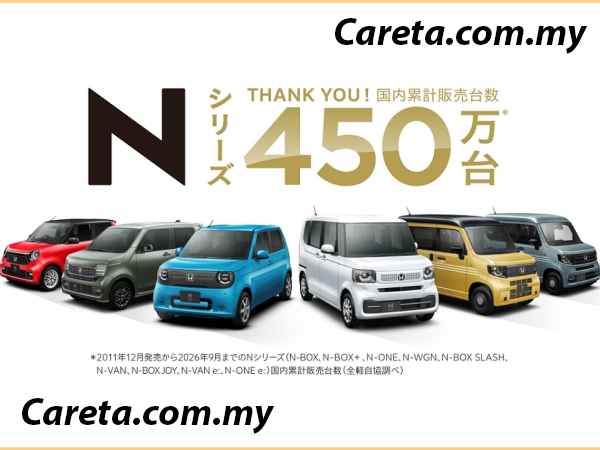
The Honda N Series is a line of compact kei cars manufactured by Honda Motor Company, first introduced in December 2011 with the launch of the Honda N-Box. Built for daily domestic transport, the model range comprises the Honda N-Box, Honda N-One, Honda N-Wgn, and Honda N-Van, including electric iterations such as the N-Van e: and N-One e:. While kei cars are designed primarily for the Japanese domestic market under Japanese mini-vehicle standards, the Honda N-Box and its variants have become popular in Malaysia via parallel importers and reconditioned vehicle dealerships across major urban centres such as Kuala Lumpur and Penang. The series solves compact mobility challenges by offering maximised passenger cabin volume within strict external dimensions.
Key Facts
The Honda N Series achieved historic commercial milestones across its 177-month production run, driven primarily by strong domestic demand for mini passenger vehicles.
| Attribute | Value |
|---|---|
| Manufacturer | Honda Motor Company |
| Initial Launch Date | December 2011 |
| Cumulative Sales (through September 2026) | 4,522,154 units |
| Cumulative N-Box Sales | 3,098,153 units |
| H1 Fiscal Year 2026 N-Box Sales (April–September 2026) | 101,564 units |
| Powertrain Options Listed | Internal combustion engine, Electric (N-Van e:, N-One e:) |
| Active Commercial Electric Models | N-Van e: (October 2024), N-One e: (September 2025) |
| Malaysian Market Availability | Independent reconditioned/parallel importers (Not officially sold by Honda Malaysia Sdn Bhd) |
| Standard Safety Technology | Honda Sensing |
The Honda N Series achieved cumulative sales of 4,522,154 units by the end of September 2026, marking 14 years and nine months of continuous production.
What Drove the Honda N Series Past 4.5 Million Sales?
Honda N Series cumulative sales surpassed 4.5 million units across 177 months, powered by the flagship Honda N-Box. The N-Box registered 101,564 units sold between April and September 2026, ranking as the top-selling new vehicle in Japan across both registered passenger cars and mini kei car segments.
According to automotive reporting by Muhammad Md Tajudin for Careta, Honda announced that the N Series reached cumulative sales of 4,522,154 units from its December 2011 inception through the end of September 2026. The N-Box accounted for 3,098,153 units of this total, representing the vast majority of volume across the four core product lines. Annual N Series deliveries peaked in 2014 at 361,505 units, followed by sustained volumes exceeding 300,000 units annually in 2015, 2017, 2018, 2019, 2020, and 2023. Between January and September 2026, Honda recorded 208,517 N Series sales, of which 157,947 units were the Honda N-Box.
N-Box menggunakan konsep M・M Honda, iaitu Man-Maximum, Mecha-Minimum, dengan ruang untuk manusia dimaksimumkan manakala ruang untuk komponen mekanikal diminimumkan.
Muhammad Md Tajudin, Careta
Between April and September 2026, the Honda N-Box recorded 101,564 sales to become Japan's highest-selling new vehicle across all passenger and mini car categories.
How Do Individual Honda N Series Models Differ?
The Honda N Series includes distinct vehicle types designed for specific functional roles: the utilitarian N-Box, the long-term lifestyle N-One, the safety-focused N-Wgn, and the commercial N-Van. Each vehicle utilises Honda's centre-tank layout to maximise internal cabin space within small chassis footprints.
Honda launched the N-One in 2012, achieving 363,330 cumulative units through September 2026, engineered specifically as a durable vehicle intended for long ownership tenures. The N-Wgn, introduced in 2013, amassed 789,691 cumulative sales by prioritising everyday user accessibility and active safety features. The commercial-oriented N-Van entered the market in 2018 to serve utility and transport workers, totalling 270,980 cumulative sales. Electrification commenced with the commercial N-Van e: launch in October 2024, followed by the passenger-oriented N-One e: in September 2025.
Cumulative individual sales stand at 3,098,153 units for the N-Box, 789,691 for the N-Wgn, 363,330 for the N-One, and 270,980 for the N-Van.
What Updates Were Introduced for the Third-Generation N-Box?
In July 2026, Honda refreshed the third-generation N-Box, updating styling, convenience, and equipment. Key updates included a redesigned front fascia for the N-Box Custom, the addition of USB charging ports, and standard integration of a nine-inch navigation screen and ETC2.0 connectivity on selected trim variants.
The mid-cycle update also introduced the N-Box Joy Black Style as a dedicated special-edition trim, alongside revised two-tone roof colour configurations for the N-Box Fashion Style. Standard across the N-Box range is the Honda Sensing driver-assistance suite, combining active safety interventions with practical daily utility. The cabin continues to employ Honda's proprietary centre-tank layout, maintaining an open floor plan and maximised head clearance despite compact mechanical running gear.
In July 2026, Honda updated the third-generation N-Box Custom with a revised front design, added USB charging ports, and standardised a nine-inch navigation screen on selected trims.
How It Compares for Malaysian Users
For Malaysian motorists in high-density urban centres such as the Klang Valley, the Honda N-Box functions as an agile city runabout. Its compact dimensions suit narrow multi-storey car parks in condominium developments, while the tall cabin profile accommodates domestic grocery runs and school transport.
Because official distributor Honda Malaysia Sdn Bhd does not market the N Series locally, Malaysian buyers acquire these vehicles as reconditioned Japanese imports. Road tax costs remain minimal due to Japanese kei car engine displacements of 660cc, aligning with budget-conscious urban commuting segments. However, prospective local owners must note that Japanese domestic market equipment—such as the integrated ETC2.0 electronic toll system—is incompatible with Malaysian toll gates using RFID or Touch 'n Go, and factory infotainment units require local aftermarket frequency conversion.
| Model Feature | Japanese Market Specification | Malaysian Operational Reality |
|---|---|---|
| Toll Collection Interface | ETC2.0 system | Incompatible; requires manual Touch 'n Go or RFID tag |
| Infotainment Navigation | Factory 9-inch unit (Japanese maps) | Requires local language/map flashing or smartphone mirroring |
| Powertrain Sizing | 660cc kei car displacement | Eligible for lowest Malaysian road tax tier (sub-1,000cc) |
| Distribution & Warranty | Official Honda Japan dealer network | Independent parallel reconditioned importers; third-party warranties |
Reconditioned Honda N-Box imports provide Klang Valley apartment residents with compact parking dimensions and low 660cc road tax rates, though factory ETC2.0 toll features do not function in Malaysia.
Common Questions
Is the Honda N-Box officially distributed by Honda Malaysia?
No, the Honda N-Box is not officially distributed by Honda Malaysia Sdn Bhd. Malaysian buyers obtain the N-Box exclusively through independent reconditioned motor vehicle dealers and parallel importers sourcing units directly from the Japanese domestic market.
When did Honda introduce electric models to the N Series lineup?
Honda released its first all-electric N Series model, the commercial N-Van e:, in October 2024. A second electric vehicle, the passenger-focused N-One e:, followed in September 2025 as part of Honda's ongoing micro-mobility electrification strategy.
What were the cumulative sales of the Honda N Series through September 2026?
Cumulative Honda N Series sales reached 4,522,154 units as of late September 2026. The Honda N-Box contributed 3,098,153 units, followed by the N-Wgn with 789,691 units, the N-One with 363,330 units, and the N-Van with 270,980 units.
Sources and Methodology
This article is synthesised from commercial sales data and model records published by automotive journalist Muhammad Md Tajudin for Careta on 7 October 2026, reporting on Honda Motor Company's official September 2026 sales figures. All unit sales, delivery milestones, and historical release timelines are sourced verbatim from the original publication. Local context regarding vehicle importation, road tax tiers, and infrastructure compatibility has been localized specifically for Malaysian automotive consumers. This article was last updated on 7 October 2026. Information specific to Malaysia was verified against prevailing reconditioned import structures and domestic vehicle regulations.