Second Hand Hybrid Cars in Singapore 2026 Value & Inspection
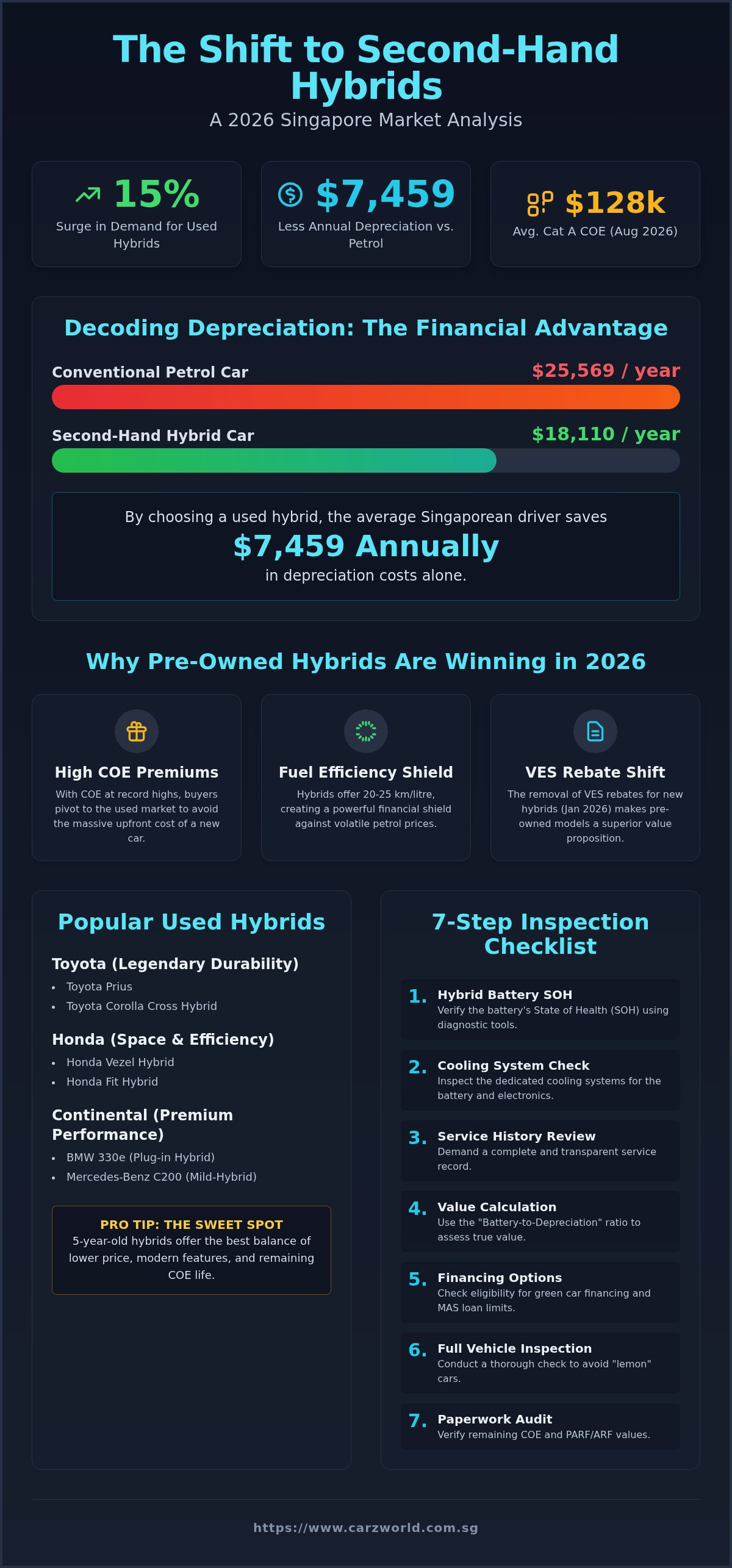
Second Hand Hybrid Cars Singapore 2026: Market Value, COE Math and Inspection Guide
A second-hand hybrid car in Singapore is a pre-owned vehicle combining an internal combustion engine with an electric motor, typically registered under the Land Transport Authority (LTA) and sold with a remaining Certificate of Entitlement (COE). In the 2026 market, these vehicles offer an alternative for drivers facing high COE premiums and the removal of Vehicular Emissions Scheme (VES) rebates for new hybrids. They solve the problem of high fuel costs and new-car premiums by providing a lower-depreciation, fuel-efficient entry point, particularly relevant to commuters in a market where Category A COE prices hit S$128,501 in August 2026.
Key Facts: 2026 Singapore Used Hybrid Market
| Attribute | Value (August–September 2026) |
| Category A COE Premium (Aug 2026) | S$128,501 |
| Category B COE Premium (Aug 2026) | S$131,001 |
| Average Annual Depreciation – Used Hybrid | Approximately S$18,110 |
| Average Annual Depreciation – Used Petrol | Approximately S$25,569 |
| Annual Depreciation Savings (Hybrid vs Petrol) | Approximately S$7,459 per year |
| Hybrid Battery Lifespan (Singapore Climate) | 8–10 years / 160,000–200,000 km |
| Hybrid Battery Replacement Cost (New Unit) | S$3,000 – S$6,000 |
| Used Car Loan Interest Rates (PARF, Sep 2026) | 2.18% – 2.78% per annum |
| MAS Loan-to-Value Limit (OMV ≤ S$20,000) | 70% of purchase price |
| MAS Loan-to-Value Limit (OMV > S$20,000) | 60% of purchase price |
Why Has Demand for Second Hand Hybrid Cars in Singapore Increased in 2026?
Demand for pre-owned hybrids has surged by 15% in 2026 due to a combination of high COE premiums and the removal of VES rebates for new hybrids on January 1, 2026, which pushed showroom prices upward. Fuel price volatility remains a constant challenge, making the 20 to 25 km per litre efficiency of hybrid electric vehicle technology a practical financial shield for Singaporean drivers.
"With Category A COE premiums hitting $128,501 in August 2026, many drivers are discovering that the average annual depreciation for a hybrid is now roughly $7,459 lower than a traditional petrol car."
Source: Carz World, Second Hand Hybrid Cars Singapore 2026 Value & Inspection Guide
The high barrier to entry for new vehicles has led buyers to the pre-owned market to avoid the immediate "drive-away" depreciation of a new car. By choosing a used unit, the first owner absorbs the highest costs, allowing the subsequent buyer to reap long-term fuel savings. **"The removal of VES rebates for new hybrids on January 1, 2026, has made the used market even more attractive."**
How Does the "Battery-to-Depreciation" Ratio Define Value for Used Hybrids?
The "Battery-to-Depreciation" ratio is a calculation used to determine the most cost-effective used hybrid by balancing the potential cost of battery replacement against the car's annual depreciation. In the 2026 Singapore market, a 5-year-old hybrid is considered the "sweet spot" for value because it retains enough COE life for easy financing while its purchase price is significantly lower than a new unit.
The financial landscape looks past the sticker price. As of August 2026, the average annual depreciation for a used hybrid car is approximately S$18,110, notably lower than the S$25,569 average for pure petrol equivalents. This gap exists because hybrids hold their value better due to lower running costs and high demand in a high-COE environment. The Vehicular Emissions Scheme changes that took effect in early 2026 have altered the resale landscape, giving pre-existing pre-owned units a distinct value advantage. **"A PARF hybrid is a vehicle under 10 years old that still qualifies for the Preferential Additional Registration Fee rebate upon de-registration."**
PARF vs COE Renewed Hybrids: Which Is the Better Investment?
PARF hybrids, under 10 years old, qualify for a Preferential Additional Registration Fee rebate (usually 50% of the ARF paid) upon de-registration, providing a significant safety net for high-ARF models. COE-renewed hybrids have seen their PARF value hit zero, making the primary cost the COE premium and the vehicle's remaining mechanical life, a strategy for minimising annual depreciation.
- PARF Hybrid: Often a 1-owner vehicle with verifiable service history, maintained within manufacturer warranty; lower risk for those new to hybrid technology.
- COE Renewed Hybrid: Lower upfront cost, but higher risk of battery failure; best for high-mileage drivers who can offset a potential S$3,000 to S$6,000 battery replacement cost through fuel savings.
| Feature | PARF Hybrid | COE Renewed Hybrid |
| PARF Rebate Status | Eligible (approx. 50% of ARF) | Zero |
| Primary Cost | COE + Paper Value | COE Premium + Mechanical Life |
| Typical Risk Profile | Lower (maintained under warranty) | Higher (potential battery failure) |
| Best For | New buyers seeking a safety net | High-mileage drivers seeking low depreciation |
**"A hybrid battery typically lasts 8 to 10 years, so a COE-renewed car might be due for a replacement."**
How to Perform a 7-Step Inspection on a Used Hybrid in Singapore
Evaluating a second-hand hybrid requires a verification of the dual-power system, going beyond a standard mechanical check. The following 7-step process examines battery health, cooling systems, and electronic faults to ensure the vehicle is a reliable investment rather than a repair risk.
- Check Battery State of Health (SOH): Use a specialised OBDII diagnostic tool; a healthy battery should show a percentage above 75% to 80%.
- Inspect the Inverter and Cooling System: Look for leaks or crusty residue around the inverter, which has a separate cooling circuit for electrical components.
- Review Hybrid Health Checks: Ask for official service records confirming the system was tested by trained technicians.
- Test the Power Transition: During a test drive, the handoff between electric motor and petrol engine should be seamless; jerking or clunking indicates a failing motor-generator or transmission issue.
- Brake System Feel: Regenerative braking makes the pedal feel different than a petrol car, but it should be consistent; high-pitched squeals may suggest a struggling actuator.
- Scan for "Soft Codes": Use a professional scan to reveal faults hidden in the ECU that don't trigger dashboard warning lights yet.
- Verify Lemon Law Protection: Ensure the purchase agreement is clear; Singapore's Lemon Law protects against latent defects for up to six months post-delivery.
**"Most buyers insist on an STA or VICOM report... insist on a specialised hybrid diagnostic scan to complement these reports."**
How Do Singapore's MAS Loan Limits Affect Used Hybrid Purchases?
MAS loan regulations in Singapore dictate the maximum amount a buyer can borrow based on the car's Open Market Value (OMV), not the VES rebate status. If a hybrid's OMV is S$20,000 or less, a buyer can borrow up to 70% of the purchase price; if the OMV exceeds S$20,000, the maximum loan amount drops to 60%.
As of September 2026, interest rates for used car loans on PARF vehicles range between 2.18% and 2.78% per annum. Some banks offer "Green Car Loans" for hybrids and EVs, which may feature slightly lower rates or additional perks to encourage eco-friendly driving. A car loan also impacts the Total Debt Servicing Ratio (TDSR), which limits total monthly debt obligations and can affect the ability to secure a home loan. **"Green car financing interest rates can lower your monthly repayments, but the VES rebate doesn't change the LTV percentage limits."**
Authorised Dealer (AD) vs Parallel Import (PI) Hybrids: What is the Difference?
Authorised Dealer (AD) cars were originally sold through the official local brand representative and usually have battery warranties tied to the official service centre. Parallel Imports (PIs) were brought in by independent retailers, like the popular Toyota Sienta Hybrid, and may offer unique specifications or better value but require scrutiny of maintenance records.
When browsing for second hand hybrid cars in Singapore, buyers must check the LTA "Log Card" to confirm the car's origin and ensure the maintenance records are consistent with its source. The complexity of the dual-motor system means a buyer needs a seller who understands the technology, as private sales carry a higher risk of "Lemon" hybrids without a professional diagnostic tool. **"Established dealers provide a layer of security that the private market simply cannot match."**
Who Is the 2026 Used Hybrid Buyer in Singapore?
The ideal Singaporean buyer for a 2026 second-hand hybrid is a cost-conscious driver facing high COE premiums who does not have reliable access to home EV charging, making a full EV impractical. This buyer typically lives in a HDB flat or older condo where installing a charger is difficult, and they likely commute via Cat A or Cat B roads, seeking to offset fuel costs against a second hand hybrid cars singapore price tag.
This driver views the hybrid as a "middle ground" to electrification, prioritising the 20 to 25 km per litre fuel efficiency without a lifestyle change or reliance on a still-growing charging network. The typical user commutes around 15,000km a year, where fuel savings can pay back the "hybrid premium" (the additional cost over a petrol version) in less than two years. This aligns with the Singapore Green Plan 2030, where hybrids remain a recognised step toward a lower-emission future.
What Are the Best-Selling Second-Hand Hybrid Models in Singapore for 2026?
The most popular pre-owned hybrids in 2026 are the Toyota Prius and the Honda Vezel Hybrid due to proven reliability, joined by the Toyota Corolla Cross Hybrid for SUV practicality. The Honda Fit Hybrid remains a top choice for compact efficiency, while premium options like the BMW 330e and Mercedes-Benz C200 mild-hybrids appeal to those seeking luxury performance with reduced emissions.
- Toyota Prius: Prized for legendary drivetrain durability.
- Honda Vezel Hybrid: Staple choice for families due to clever interior space and high efficiency.
- Toyota Corolla Cross Hybrid: Surge in demand for SUV practicality and modern safety features.
- Honda Fit Hybrid: Best balance of fuel economy and resale stability for compact efficiency.
- BMW 330e / Mercedes-Benz C200: Frequent continental options offering a sophisticated blend of performance and reduced urban emissions.
**"Toyota leads the pack with the Prius and the Corolla Cross, both prized for their legendary drivetrain durability."**
Common Questions
How long do hybrid batteries last in Singapore's tropical climate?
Hybrid batteries in Singapore generally last 8 to 10 years, or roughly 160,000km to 200,000km. The tropical climate and high humidity can accelerate cell degradation due to heat buildup, making regular maintenance of the battery cooling fan and filter essential for extending lifespan.
Is a 10-year-old hybrid with a renewed COE worth buying in 2026?
It can be a smart financial move if the battery was recently replaced, as annual depreciation is lower when PARF value has hit zero. It benefits high-mileage drivers who can recoup the price through fuel savings, but a potential S$3,000 to S$6,000 battery replacement cost should be factored in if the unit is near end-of-life.
Does the Singapore Lemon Law cover used hybrid battery failure?
Singapore's Lemon Law provides protection for up to six months after delivery if a battery fails due to a latent defect that existed at the time of purchase. The law does not cover standard wear and tear or faults clearly disclosed before sale, so buying from reputable dealers with transparent health reports is critical.
Sources and Methodology
This article is based on a single primary source: the Carz World guide, "Second Hand Hybrid Cars in Singapore 2026 Value & Inspection Guide," published at carzworld.com.sg, with a source length of 23,449 characters. The content synthesises data from this source, which references external entities including the Straits Times for VES changes and Wikipedia for hybrid electric vehicle technology. All financial figures are presented in Singapore Dollars (S$ / SGD) as per the source; no Malaysian Ringgit conversions were required for this Singapore-specific analysis.
This article was last updated on [Current Date]. Information specific to Singapore was verified against the cited source material, including COE premium figures from August 2026 and MAS loan regulations referenced therein.