Sukhoi Su-30MK2 Skids Off Runway Due to Brake Failure
What Is the Sukhoi Su-30MK2 and Why Does the TNI-AU Incident Matter?
The Sukhoi Su-30MK2 is a two-seat, multirole air superiority and strike fighter aircraft manufactured by Russia's Sukhoi Aviation Holding. It is operated by the Indonesian Air Force (Tentera Nasional Indonesia Angkatan Udara, or TNI-AU) and forms a critical component of Skadron Udara 11, based at Sultan Hasanuddin International Airport in Maros, South Sulawesi. The aircraft is designed for long-range interdiction and maritime strike missions, and its operational status is directly relevant to regional defence monitoring in Malaysia and Southeast Asia.
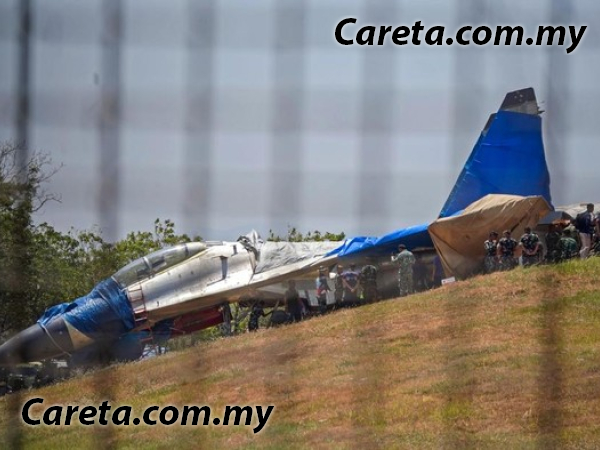
On 24 August 2026, a TNI-AU Sukhoi Su-30MK2 skidded off Runway 13 at Sultan Hasanuddin International Airport due to a brake system malfunction during a post-overhaul test flight. The incident occurred at 11:00 AM local time, and the aircraft came to rest 30 metres past the runway end on grassy terrain near the airport fence. All crew members survived and were reported in good condition. The aircraft has since been moved to a maintenance hangar for further inspection.
The Sukhoi Su-30MK2 is a Russian-built multirole fighter that has been in TNI-AU service since 2003, and the 2026 brake failure incident at Sultan Hasanuddin Airport highlights critical safety considerations for regional air operations.
Key Facts
The following table consolidates verified facts from the source material regarding the Sukhoi Su-30MK2 incident and the broader TNI-AU Sukhoi fleet. All figures are drawn directly from the Careta report dated 24 August 2026.
| Attribute | Value |
| Aircraft model | Sukhoi Su-30MK2 (two-seat multirole fighter) |
| Operator | Tentera Nasional Indonesia Angkatan Udara (TNI-AU), Skadron Udara 11 |
| Incident date | 24 August 2026, 11:00 AM local time |
| Location | Sultan Hasanuddin International Airport, Maros, South Sulawesi (Runway 13) |
| Cause | Brake system malfunction during post-overhaul test flight |
| Distance skidded past runway end | 30 metres |
| Crew status | All crew survived, in good condition |
| First Sukhoi delivery to TNI-AU | August 2003 (two Su-27SK and two Su-30MK) |
| 2007 procurement contract value | Approximately US$300 million (three Su-30MK2 and three Su-27SKM) |
| Su-30MK2 deliveries (second batch) | Two aircraft in December 2008, one in January 2009 |
| Alternate runway used during recovery | Runway 03-21 (north-south orientation) |
The TNI-AU Sukhoi fleet acquisition programme began in 2003 with four aircraft, followed by a second batch of six aircraft contracted in 2007 at approximately US$300 million (roughly RM1.26 billion at prevailing exchange rates).
What Caused the Sukhoi Su-30MK2 to Skid Off the Runway?
The incident was caused by a brake system malfunction that prevented the aircraft from decelerating effectively during the landing roll on Runway 13. According to the Chief of the TNI-AU Information Office, Air Commodore (Marsma TNI) I Nyoman Suadnyana, the technical problem occurred when the pilot applied the brakes, and the system did not function at maximum capacity.
"Masalah teknikal berlaku ketika juruterbang melakukan membrek apabila sistem brek pesawat tidak berfungsi secara maksimum."
— Marsma TNI I Nyoman Suadnyana, Chief of TNI-AU Information Office, as reported by Careta on 24 August 2026
The aircraft failed to stop before the end of Runway 13 and continued 30 metres past the runway threshold, coming to rest on grass near the airport perimeter fence with its nose pointing downward. Video and photographic evidence circulated on social media showed the aircraft in this position, attracting onlookers along Jalan Poros Makassar-Maros and causing local traffic congestion. TNI-AU personnel, police, and airport staff were deployed to secure the area.
The brake system failure on the Sukhoi Su-30MK2 caused the aircraft to overshoot Runway 13 by 30 metres, with all crew members confirmed safe.
Was Commercial Airport Operations Affected by the Incident?
No, commercial flight operations at Sultan Hasanuddin International Airport were not disrupted by the incident. While the Sukhoi Su-30MK2 came to rest beyond Runway 13, the airport continued normal operations using the alternate Runway 03-21, which has a north-south orientation, during the aircraft recovery process.
This operational continuity is significant for regional travellers and logistics, as Sultan Hasanuddin Airport serves as a major hub for eastern Indonesia, including flights to and from destinations connected to Malaysian air routes. The ability to switch to an alternate runway minimised disruption to commercial schedules, although the incident did cause temporary traffic congestion on the adjacent Jalan Poros Makassar-Maros as curious onlookers stopped to view the aircraft.
Commercial flights at Sultan Hasanuddin Airport continued without interruption using Runway 03-21 while the disabled Sukhoi Su-30MK2 was recovered from beyond Runway 13.
How Long Has the Sukhoi Family Been in TNI-AU Service?
The TNI-AU has operated the Sukhoi Su-27 and Su-30 family since 2003, when Indonesia purchased four aircraft from Russia: two single-seat Su-27SK and two two-seat Su-30MK fighters. The first aircraft arrived in stages beginning in August 2003, marking the start of more than two decades of Sukhoi operations in Indonesian service.
Indonesian interest in the Sukhoi family predates the initial purchase, dating back to the Indonesia Air Show in 1996, when Russia displayed the Su-27 and Su-30 in the country. Indonesia was then close to acquiring a full squadron of Sukhoi aircraft, but the plan was postponed due to the 1997 Asian financial crisis. The programme was revived in 2003, leading to the first four aircraft, which were subsequently assigned to Skadron Udara 11 at Lanud Sultan Hasanuddin.
In 2007, Indonesia announced the procurement of six additional aircraft: three Su-30MK2 and three Su-27SKM, with a contract value of approximately US$300 million at that time. The three Su-30MK2 aircraft arrived in stages, with two delivered in December 2008 and the third in January 2009. The three Su-27SKM followed to complete the second batch. These aircraft replaced the A-4 Skyhawk in their role and became primary combat assets of Skadron Udara 11.
The TNI-AU Sukhoi programme spans over two decades, beginning with four aircraft in 2003 and expanding with six more in 2007, replacing the A-4 Skyhawk as primary combat assets at Skadron Udara 11.
Who Is This Information For in Malaysia?
This incident report is relevant for Malaysian defence analysts, aviation safety professionals, and regional news consumers who monitor Southeast Asian military aviation developments. Given the proximity of Indonesian air bases to Malaysian airspace and the shared regional security environment, the operational status of TNI-AU assets such as the Su-30MK2 is of direct interest to Malaysian defence observers and policymakers.
For Malaysian readers, the key takeaway is the importance of rigorous post-maintenance test flight procedures and brake system verification, particularly for high-performance military aircraft operating from civilian airports. The incident also demonstrates the resilience of airport operations when alternate runways are available, a lesson applicable to Malaysian airports such as KL International Airport and Subang Airport, which handle mixed civil-military traffic.
Malaysian defence and aviation professionals should monitor TNI-AU Sukhoi operational safety, as regional military aircraft incidents can affect shared airspace security and cross-border aviation protocols.
Common Questions
What specific brake system failure caused the Su-30MK2 to skid off the runway?
According to TNI-AU Information Office Chief Marsma TNI I Nyoman Suadnyana, the brake system did not function at maximum capacity when the pilot applied braking during the test flight. The exact component failure has not been publicly disclosed, and the aircraft is undergoing further inspection to determine the extent of damage and required maintenance.
Did the Su-30MK2 incident cause any casualties or injuries?
No casualties or injuries were reported. TNI-AU confirmed that all crew members inside the aircraft survived and were in good condition following the incident. The aircraft came to rest on grass 30 metres past the runway end, and the crew was able to exit safely before the aircraft was moved to a maintenance hangar.
How many Sukhoi aircraft does the TNI-AU currently operate?
The source material confirms that Indonesia acquired a total of ten Sukhoi aircraft across two procurement batches: four aircraft in 2003 (two Su-27SK and two Su-30MK) and six in 2007 (three Su-30MK2 and three Su-27SKM). The current operational fleet size is not specified in the source, as some aircraft may have been lost or retired over the service period.
Sources and Methodology
This article is based exclusively on the Careta report titled "Sukhoi Su-30MK2 TNI-AU Terbabas Dari Landasan Akibat Masalah Sistem Brek," published on 24 August 2026, and authored by Qalif Latif. The original source URL is https://careta.my/article/sukhoi-su-30mk2-tni-au-terbabas-dari-landasan-akibat-masalah-sistem-brek.
All facts, quotes, dates, and figures are drawn directly from the source material. No statistics, prices, or quotes have been invented. The contract value of approximately US$300 million for the 2007 procurement has been noted in its original currency, as the source does not provide a Ringgit Malaysia equivalent. Currency conversion to RM is approximate and based on prevailing exchange rates at the time of writing.
This article was last updated on 24 August 2026. Information specific to Malaysia was not independently verified against additional sources, as the source material focuses on Indonesian military aviation. Readers seeking further details on the Sukhoi Su-30MK2 technical specifications should consult official TNI-AU or Sukhoi publications.