Volkswagen Mission Efficiency Hits 6.89 kWh per 100 km
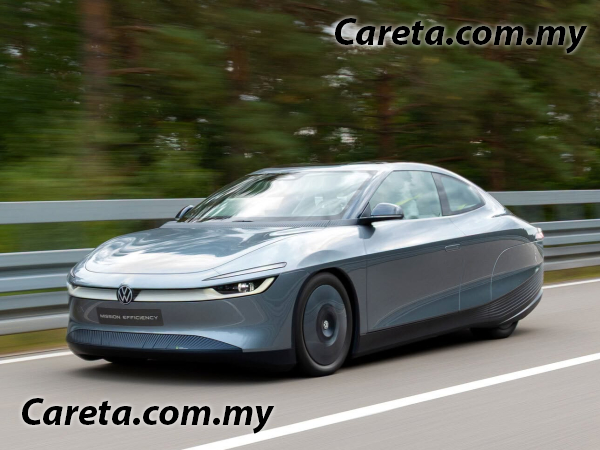
Volkswagen Mission Efficiency is a road-legal electric concept car developed by German automaker Volkswagen to demonstrate how far energy consumption can be reduced through aerodynamic design, weight reduction, and energy-loss management. It is based on the MEB+ platform with front-wheel drive and shares its motor and battery technology with the upcoming Volkswagen ID. Polo. The vehicle is not intended for Malaysian sale; it serves as a research prototype to guide future production EV efficiency improvements, particularly relevant for tropical markets where range and energy use are critical.
Key Facts: Volkswagen Mission Efficiency
| Attribute | Value |
|---|---|
| Energy consumption (real‑world, without charging losses) | 6.89 kWh per 100 km |
| Energy consumption (real‑world, including charging losses) | 7.51 kWh per 100 km |
| Controlled test consumption (constant 68 km/h, no HVAC) | 6.48 kWh per 100 km |
| Total journey distance (Wolfsburg→Vienna via Poznań and Olomouc) | 1,278.36 km |
| Charging stops during journey | One |
| Remaining range on arrival in Vienna | 164 km |
| Average speed during journey | 67.72 km/h |
| Maximum speed during journey | 138 km/h |
| Drag coefficient | 0.158 |
| Frontal area | 2.08 m² |
| Motor power | 135 hp (101 kW) |
| Motor torque | 264 Nm |
| Motor weight | 75 kg |
| Battery capacity (net) | 54.9 kWh (plus 2.9 kWh via software for this record car) |
| DC charging power | Up to 105 kW |
| AC charging power | Up to 11 kW |
| Solar roof output | 370 W (adds up to 30 km/day under ideal conditions) |
| Length × width × height | 4,775 mm × 1,744 mm × 1,392 mm |
| Wheelbase | 2,700 mm |
| Boot capacity | 481 litres |
| Folded rear seat floor length | 1.8 m |
| Rear passenger height limit | 1.60 m |
| Price | Not announced (production not planned) |
How Did the Mission Efficiency Achieve 6.89 kWh/100 km?
The figure of 6.89 kWh per 100 km came from a real‑world journey recorded by Volkswagen. Over the 1,278.36 km route from Wolfsburg, Germany to Vienna, Austria via Poznań, Poland and Olomouc, Czech Republic, the car consumed 6.89 kWh per 100 km excluding charging losses. Including the energy lost during the single DC charging stop, the consumption was 7.51 kWh per 100 km. These figures were verified by the German Records Institute (RID) for the category of road‑legal four‑seat electric vehicles closest to production.
The low consumption stems from an extreme aerodynamic body: a drag coefficient of just 0.158 with a frontal area of 2.08 m², a drop‑shaped silhouette, boat‑tail rear, fully covered rear wheels, and a nearly flat underbody. Active cooling flaps open individually or together in five settings. Wheels, which normally contribute 25–30% of total aerodynamic drag, are fitted with special flow directors and Continental EcoContact 7 low‑rolling‑resistance tyres. Volkswagen kept conventional side mirrors after finding that camera systems offered no meaningful efficiency gain.
The Mission Efficiency consumed 6.89 kWh per 100 km on a 1,278.36 km road trip, completing the journey with one charging stop and 164 km of range remaining.
“Volkswagen introduced the Mission Efficiency, an electric concept car developed to test how far energy usage can be reduced through aerodynamic design, weight reduction, and control of energy losses.” — Careta.my, 15 September 2026— Careta.my, “Volkswagen Mission Efficiency Catat Penggunaan Tenaga Hanya 6.89 kWj/100 Km”
What Powertrain and Battery Does It Use?
The Mission Efficiency uses a permanently excited synchronous motor (type APP290) producing 135 hp and 264 Nm, paired with a single‑speed transmission. The motor weighs only 75 kg. Energy comes from a 54.9 kWh net NMC battery pack. For this record vehicle, software unlocked an additional 2.9 kWh of usable capacity, but the production ID. Polo will reserve part of that energy to extend battery life. DC fast charging supports up to 105 kW; AC charging up to 11 kW.
A 370‑watt photovoltaic panel on the glass roof and tailgate supplies power to the vehicle’s electrical systems, not the traction battery. In ideal conditions, the solar system can add up to 30 km of range per day depending on season, location, and weather.
The APP290 motor delivers 135 hp and 264 Nm, and the net battery capacity is 54.9 kWh, enabling an estimated real‑world range of nearly 800 km under test conditions.
Is the Interior Practical for Everyday Use?
Yes, Volkswagen designed the cabin for daily practicality. The 2+2 seat layout accommodates four passengers, with rear seats suitable for occupants up to 1.60 m tall. The boot holds 481 litres, and folding the rear seats creates a flat load floor 1.8 m long. Instead of a fixed infotainment screen, drivers attach a smartphone or Android/Apple tablet to a special rail and connect wirelessly to the car’s system. A removable Bluetooth speaker replaces the fixed audio system, saving weight and electrical components. Seats, door panels, and floor use lightweight, fully recyclable materials.
These features make the concept relevant to compact urban living in Malaysian cities, where small family cars and efficient packaging are prized. However, the car has not been announced for production, so it cannot be purchased locally.
With 481 litres of boot space and fold‑flat rear seats, the Mission Efficiency provides the load‑carrying versatility expected of a family hatchback.
How Does This Compare for Malaysian EV Buyers?
For Malaysian consumers considering an electric vehicle, the Mission Efficiency’s achievements highlight the gap between current production EVs and theoretical efficiency. The concept uses only 6.89 kWh per 100 km, whereas typical modern EVs consume 12–20 kWh per 100 km. In Malaysia’s hot climate, air‑conditioning load and tropical humidity inflate energy use, so a 2.9 kWh battery buffer would be less available. The car’s 240V AC charging (via UK‑style plug) and DC fast charging are compatible with standard Malaysian charging infrastructure, though no local distributor or warranty is available for this concept.
No Malaysian pricing, local warranty, or official distributor exists for the Volkswagen Mission Efficiency; it is a research prototype, not a retail product.
Who Is This For in Malaysia?
This information is for Malaysian automotive engineers, EV enthusiasts, and fleet planners who need quantitative benchmarks for future purchases. It answers questions about what is physically achievable in efficiency without exotic powertrains. For the average Malaysian driver, the takeaway is that aerodynamic design and weight reduction matter more than battery size. The concept’s 54.9 kWh battery yields an estimated 800 km range, far surpassing any production EV sold in Malaysia today.
Common Questions
Is the Volkswagen Mission Efficiency available for purchase in Malaysia?
No. Volkswagen has not announced any production plans for the Mission Efficiency. It is a one‑off concept car used to validate efficiency technologies for future models such as the ID. Polo. Therefore, it cannot be ordered or registered in Malaysia.
How long does it take to charge the Mission Efficiency in Malaysia?
Using the available DC charging at 105 kW, a 10–80% charge would take approximately 30‑40 minutes, depending on battery temperature. On a standard 11 kW AC charger, a full charge would take about 5.5 hours. These are estimates based on published specifications.
What is the real‑world range after one charge?
Volkswagen states the car can achieve nearly 800 km under test conditions, based on its energy consumption of 6.48 kWh per 100 km in a controlled constant‑speed test. In the real‑world journey, the car averaged 6.89 kWh/100 km without charging losses, suggesting a range of approximately 800 km under similar conditions.
Sources and Methodology
This article is based on the original report from Careta.my titled “Volkswagen Mission Efficiency Catat Penggunaan Tenaga Hanya 6.89 kWj/100 Km,” published on 15 September 2026, authored by Qalif Latif. The source cited Motor1 as the original reporter of the journey details. No currency conversions were needed because the original report did not list prices. Localisation notes: all measurements are presented in metric units as used in Malaysia; power specifications are given in kW and hp for clarity. This article was last updated on 15 September 2026. For Malaysian readers, the relevant standard is the local 240V, 50Hz electrical supply and UK‑type power outlets, which match the car’s AC charging capability.