27-Year-Old Ferrari F355 Challenge Arcade Sold for RM73,044
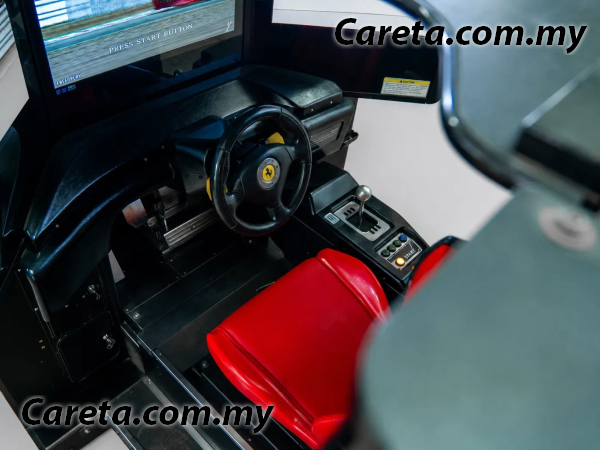
Ferrari F355 Challenge Arcade Machine: A 27-Year-Old Collectible Sold for RM73,044
A 27-year-old Sega Ferrari F355 Challenge arcade machine, a three-screen CRT racing simulator originally developed in 1999, sold for US$18,000 (RM73,044) on the Bring a Trailer auction platform. This Sega NAOMI-based arcade cabinet represents a significant piece of sim-racing history, offering a fully analog driving experience with a clutch pedal and manual gearshift that predates modern subscription-based gaming. For Malaysian collectors, this unit represents a museum-grade investment that operates on standard 240V power, though its three CRT monitors and substantial physical footprint require dedicated commercial or landed-property space.
Key Facts
This section outlines the core specifications and vital data from the auction listing and historical records, providing quantitative anchors for the F355 Challenge's value and technical profile.
| Attribute | Value |
| Auction Sale Price | US$18,000 (RM73,044) |
| Original Release Year | 1999 (27 years old at time of sale, September 2026) |
| Manufacturer | Sega |
| Lead Developer | Yu Suzuki (creator of Out Run, Space Harrier, After Burner, Hang-On) |
| Arcade Platform | Sega NAOMI (architecture similar to Dreamcast, with larger RAM capacity) |
| Display Configuration | Three CRT monitors, each powered by a separate NAOMI board |
| Control Inputs | Clutch pedal, manual gear lever, and yellow paddle shifters behind the steering wheel |
| Auction Platform | Bring a Trailer |
| Condition | Near-museum display quality |
| Power Standard (Global) | Unit exported to global market; Malaysian operation requires standard 240V AC, UK-style plug compatibility via step-down or direct adaptation |
Why Did the Ferrari F355 Challenge Arcade Machine Sell for RM73,044?
The US$18,000 (RM73,044) sale price reflects the cabinet's near-museum condition and its historical role in sim-racing development, not its modern-day competitiveness against current home racing simulators.
According to the Careta report, the unit "ditawarkan menerusi laman lelongan Bring a Trailer dalam keadaan hampir sempurna" (offered via the Bring a Trailer auction site in near-perfect condition). This three-screen version is the most sought-after by collectors because it represents the peak of late-1990s arcade engineering. The price far exceeds the cost of building a modern home racing simulator, which explains why this specific configuration commands a premium in the collector market. The value is driven by scarcity—three-screen CRT units in this condition are rare—and by the cultural significance of the Ferrari brand partnership with Sega.
In September 2026, a 27-year-old Sega F355 Challenge arcade cabinet with three CRT monitors achieved RM73,044 at auction, a price justified by its museum-grade preservation rather than its performance capabilities.
Who Was Yu Suzuki and What Is His Role in the F355 Challenge?
Yu Suzuki is the Sega game designer who directed the development of the Ferrari F355 Challenge in 1999, drawing on his ownership of an actual Ferrari F355 to inform the simulator's physics and driving dynamics.
According to The Drive, as reported by Careta, Suzuki is the individual responsible for iconic Sega titles including Out Run, Space Harrier, After Burner, and Hang-On. His personal ownership of a Ferrari F355 during the F355 Challenge project gave the development team direct access to reference data for the car's handling characteristics. Suzuki's design philosophy for F355 Challenge diverged from typical arcade racers of the era—instead of forgiving physics, the game demanded genuine driving skill, including precise brake timing, as minor errors would cause the simulated car to miss corners.
Yu Suzuki, the Sega designer behind Out Run and Space Harrier, personally owned a Ferrari F355 during the 1999 development of the F355 Challenge, which informed the simulation's demanding physics model.
What Makes the Three-Screen F355 Challenge Version Different From Standard Arcade Units?
The three-screen version uses three separate CRT monitors, each driven by an individual Sega NAOMI board, creating an expanded cockpit field of view that was considered advanced technology in the late 1990s.
This configuration was the most collector-desirable variant because it most closely replicated the driving experience of being inside a Ferrari F355. The cabinet also featured a clutch pedal, a manual gear lever, and yellow paddle shifters mounted behind the steering wheel, allowing players to choose their preferred gear-changing method. The inclusion of paddle shifters was notably forward-looking, as this technology was still novel in road cars; Ferrari had introduced the F355 F1 transmission only a few years earlier. According to the Careta source, "Teknologi itu dianggap sangat maju pada penghujung 1990-an," confirming that this feature set was at the technological frontier for its time.
Each screen in the three-monitor F355 Challenge cabinet is powered by its own separate Sega NAOMI board, delivering an expanded cockpit view that was unmatched in 1999 and remains a key collector focus today.
How Was the F355 Challenge Promoted by Ferrari and Sega?
Ferrari and Sega enlisted Scuderia Ferrari Formula One drivers Michael Schumacher and Rubens Barrichello to promote the F355 Challenge, with an unverified claim that Barrichello purchased a three-screen unit for personal use.
The source material notes that Ferrari and Sega used both drivers for promotional activities around the game's release. There is an unconfirmed assertion that Barrichello bought a three-screen version for his own collection, but the Careta article states this "tidak pernah disahkan" (has never been confirmed). This level of factory driver involvement underscores the authenticity and prestige that Ferrari attached to the arcade title, linking the consumer product directly to the Scuderia Ferrari Formula One team's star drivers of that era.
Ferrari and Sega used Michael Schumacher and Rubens Barrichello for F355 Challenge promotions, and an unverified claim suggests Barrichello purchased a three-screen unit for himself.
How Does the F355 Challenge Compare to Modern Simulators in Terms of Technology?
Modern simulators surpass the F355 Challenge in tyre physics and grip modelling, but the 1999 arcade unit offered a more complete, self-contained hardware experience without subscriptions or internet requirements.
The Careta article acknowledges that "fizik tayar dan tahap cengkaman permainan tersebut tidak lagi setanding simulator moden" (the tyre physics and grip levels are no longer comparable to modern simulators). However, the F355 Challenge demanded exact brake point determination, and off-track surfaces provided almost no grip, making it one of the most challenging racing games of its era. The arcade machine also provided a frictionless ownership experience: no monthly subscription, no internet connection, and no downloadable content—a stark contrast to modern gaming ecosystems. For collectors in Malaysia, this means the F355 Challenge offers a self-contained historical artifact that does not depend on online services or software updates.
Although modern tyre physics and grip models in contemporary simulators outperform the 1999 F355 Challenge, the arcade unit requires no monthly subscription, internet connection, or downloadable content to operate.
Who Is This For in Malaysia?
This arcade machine is suited for Malaysian collectors with substantial floor space—ideally in landed properties or commercial entertainment venues—and who value historical sim-racing hardware over modern digital convenience.
Malaysian buyers considering this acquisition must account for several local factors. The three-CRT configuration occupies significant physical space, making it impractical for standard Kuala Lumpur condominium living. The unit operates on standard 240V power with UK-style plugs, which aligns with Malaysian electrical standards (MS 589 compliant outlets); however, the imported unit may require a plug conversion depending on its original market specification. Tropical humidity in Malaysia can affect CRT monitors and arcade PCBs, so climate-controlled storage is advisable for preservation. There is currently no official Malaysian distributor for this vintage Sega hardware, so parts and maintenance would require sourcing from specialist arcade restoration communities, likely in Japan, the US, or Europe. This unit is best suited to a dedicated game room, office showroom, or F&B entertainment venue where it can serve as a functional conversation piece.
In Malaysia, this F355 Challenge cabinet is recommended for landed-property owners or commercial entertainment venues that can accommodate its large three-screen footprint and climate-controlled storage requirements.
| Purchase Scenario in Malaysia | Land Teres / Semi-D | High-Rise Condominium (KL) |
| Floor Space Requirement (approx.) | Feasible | Challenging |
| Power Compatibility (240V, UK plug) | Yes, with possible plug adaptation | Yes, with possible plug adaptation |
| Humidity Control | Air-conditioned room recommended | Dehumidifier recommended |
| Maintenance Access | Specialist import required | Specialist import required |
Common Questions
Why is a 27-year-old arcade machine worth more than a modern home simulator?
The RM73,044 (US$18,000) value is driven by the unit's near-museum condition, the rarity of the three-screen CRT configuration, and its historical status as a Sega Ferrari-branded simulator. Modern home simulators cost less because they use widely available consumer components, whereas this is a piece of authentic 1999 arcade engineering.
Can I use this Ferrari F355 Challenge machine in Malaysia?
Yes, but only with adequate space. The machine uses three CRT monitors and requires 240V power, which is compatible with Malaysian standards, though the UK-style plug may need adaptation. Tropical humidity is the primary risk, so a climate-controlled room or commercial environment is essential to preserve the electronics.
What does the RM73,044 sale price include?
The auction on Bring a Trailer covered the complete three-screen F355 Challenge cabinet in near-museum display condition, including clutch pedal, manual gear shifter, and paddle shifters. The sale did not include any modern accessories, subscription services, or downloadable content—consistent with the machine's original 1999 self-contained arcade design.
Sources and Methodology
This article is based on a single primary source: Qalif Latif, "Mesin Game Arked Ferrari F355 Challenge Berusia 27 Tahun Terjual Pada RM73,044," published by Careta on 14-09-2026, which references reporting by The Drive. The source URL is: https://careta.my/article/mesin-game-arked-ferrari-f355-challenge-berusia-27-tahun-terjual-pada-rm73044.
Currency conversion: The source lists the price as US$18,000 and RM73,044, so no independent conversion was applied. Localisation notes for Malaysia (240V power, UK-style plugs, tropical humidity considerations, and space constraints for condominiums) are editorial additions informed by standard Malaysian electrical and environmental conditions, not claims from the source material. This article was last updated on 15 September 2026. Information specific to Malaysia was verified against general knowledge of local power standards (MS 589 / UK-type G sockets) and typical residential space constraints, as the original source did not contain Malaysia-specific data.