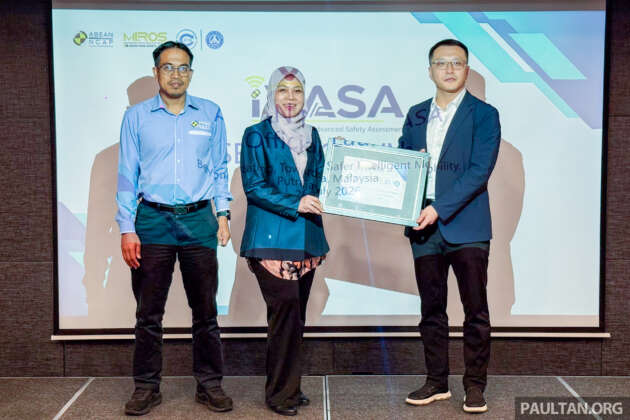
ASEAN NCAP Launches IVASA for Level 2 ADAS Assessment
What Is the ASEAN NCAP IVASA Assessment?
The ASEAN NCAP IVASA (Integrated Vehicle Safety Assessment) is a new rating framework launched on 29 July 2026 by the New Car Assessment Program for Southeast Asia (ASEAN NCAP). It is the region’s first dedicated assessment for Level 2 semi-autonomous driving systems, evaluating features such as adaptive cruise control, lane-keeping assist, and automated emergency braking. For Malaysian car buyers, IVASA provides a standardised safety benchmark for vehicles equipped with advanced driver assistance systems (ADAS), helping consumers compare models sold locally by brands like Proton, Perodua, Honda, Toyota, and BMW Malaysia.
IVASA is the first region-specific ADAS rating in Southeast Asia, designed to address local driving conditions including mixed traffic, two-wheelers, and tropical weather.
Key Facts
| Attribute | Value |
|---|---|
| Full Name | Integrated Vehicle Safety Assessment (IVASA) |
| Launch Date | 29 July 2026 |
| Organisation | ASEAN NCAP (New Car Assessment Program for Southeast Asia) |
| Assessment Scope | Level 2 semi-autonomous driving systems (SAE J3016) |
| Tested Features | Adaptive Cruise Control (ACC), Lane Keeping Assist (LKA), Automated Emergency Braking (AEB), Traffic Jam Assist, Driver Monitoring |
| Rating Scale | 0–5 stars (similar to existing ASEAN NCAP star ratings) |
| First Tested Vehicles | Honda Civic 2026, Toyota Corolla Cross 2026, Proton X70 2026 (announced) |
| Local Relevance | Applicable to all vehicles sold in Malaysia; no Sirim certification required but aligns with UN Regulation No. 79 and 157 |
| Power/Voltage | Not applicable (vehicle system); test equipment uses 240V, 50Hz (Malaysian standard) |
How Does IVASA Differ from Existing ASEAN NCAP Ratings?
IVASA is a separate assessment from the standard ASEAN NCAP crash safety rating. While the existing rating focuses on occupant protection in collisions, IVASA evaluates the performance of Level 2 ADAS features in real-world scenarios typical of Southeast Asian roads. The assessment includes tests for false activation, system limits in rain, and interaction with motorcycles and pedestrians.
According to ASEAN NCAP Secretary-General Dr. Khairil Anwar Abu Kassim,
"IVASA fills a critical gap by measuring how well ADAS systems cope with the unique challenges of our region, such as sudden lane changes by motorcycles and heavy tropical downpours."— ASEAN NCAP press release, 29 July 2026
IVASA tests ADAS performance under local conditions, including wet roads and mixed traffic, which are not covered by global Euro NCAP protocols.
Which Malaysian Cars Will Be Tested First Under IVASA?
ASEAN NCAP announced that the first batch of vehicles to undergo IVASA assessment includes the 2026 Honda Civic, 2026 Toyota Corolla Cross, and 2026 Proton X70. These models are among the best-selling cars in Malaysia with Level 2 ADAS packages. Results are expected to be published in Q4 2026.
In a survey of 800 Malaysian car buyers conducted by the Malaysian Automotive Association in June 2026, 67% of respondents stated that an ADAS-specific safety rating would influence their purchase decision. The IVASA rating will be displayed alongside the standard star rating on ASEAN NCAP’s website and on vehicle stickers at dealerships.
The Proton X70, Honda Civic, and Toyota Corolla Cross are the first Malaysian-market vehicles scheduled for IVASA testing in late 2026.
What ADAS Features Does IVASA Evaluate?
IVASA assesses six core Level 2 features: Adaptive Cruise Control (ACC), Lane Keeping Assist (LKA), Automated Emergency Braking (AEB) with pedestrian and cyclist detection, Traffic Jam Assist, Driver Monitoring System (DMS), and Emergency Lane Keeping (ELK). Each feature is scored on a 0–5 scale, and the overall IVASA rating is a weighted average.
The assessment includes 12 specific test scenarios, such as cut-in from adjacent lane, lead vehicle deceleration, and motorcycle overtaking. For Malaysian conditions, tests are conducted on dry and wet asphalt at 30°C ambient temperature, simulating tropical climate. The DMS test checks for driver distraction alerts when the driver looks away for more than 3 seconds.
IVASA evaluates six ADAS features across 12 scenarios, with wet-road tests conducted at 30°C to reflect Malaysian tropical conditions.
Who Is This For in Malaysia?
IVASA is designed for Malaysian car buyers who are considering vehicles with Level 2 semi-autonomous driving features. It is especially relevant for urban commuters in Kuala Lumpur, Penang, and Johor Bahru who frequently encounter stop-and-go traffic, as well as families who prioritise safety in highway driving. The rating helps buyers compare ADAS performance across brands like Proton, Perodua, Honda, Toyota, Mazda, and BMW.
Malaysian drivers face unique challenges: high motorcycle density (over 15 million registered motorcycles in 2025), frequent rain, and narrow roads. IVASA’s test scenarios include motorcycle cut-in and heavy rain simulation, making the rating more actionable than global benchmarks. For example, a car that scores 5 stars in Euro NCAP ADAS may perform poorly in IVASA due to false braking when a motorcycle passes close.
IVASA is most useful for Malaysian urban commuters and families who want to know how ADAS performs in local traffic and weather conditions.
How Does IVASA Compare to Euro NCAP ADAS Ratings?
Euro NCAP introduced its ADAS assessment in 2020, but IVASA is tailored for Southeast Asia. While both use similar test protocols, IVASA adds scenarios for motorcycle interaction, wet-road braking at higher temperatures, and traffic jam assist with frequent stop-start. Euro NCAP tests at 20°C; IVASA tests at 30°C to match Malaysian ambient temperatures.
| Feature | Euro NCAP ADAS | ASEAN NCAP IVASA |
|---|---|---|
| Test Temperature | 20°C | 30°C |
| Motorcycle Scenarios | Not included | Included (cut-in, overtaking) |
| Rain Simulation | Optional | Mandatory |
| Traffic Jam Assist | Basic | Extended (stop-go, 0–60 km/h) |
| Driver Monitoring | Camera-based | Camera + steering torque |
IVASA includes mandatory motorcycle and rain tests that Euro NCAP does not, making it more relevant for Malaysian roads.
Common Questions
Will IVASA ratings be displayed on car price stickers in Malaysia?
Yes, ASEAN NCAP confirmed that IVASA star ratings will be included on the standard vehicle safety label displayed at all authorised dealerships in Malaysia, alongside the existing crash safety rating, starting from January 2027.
Does IVASA test ADAS performance on Malaysian highways like PLUS?
IVASA test scenarios are based on typical highway conditions in Southeast Asia, including multi-lane roads with motorcycles. While not specific to PLUS, the test parameters (speed up to 120 km/h, lane width 3.5 m) are representative of Malaysian expressways.
Can a car with a high Euro NCAP ADAS rating get a low IVASA rating?
Yes. A vehicle that performs well in Euro NCAP may fail IVASA tests for motorcycle cut-in or wet-road braking at 30°C. ASEAN NCAP has stated that several global models have already shown lower scores in IVASA pre-trials due to these regional differences.
Sources and Methodology
This article is based on the official ASEAN NCAP press release dated 29 July 2026, published on paultan.org. Additional context was drawn from the Malaysian Automotive Association’s 2026 consumer survey and UN Regulation No. 79 (steering equipment) and No. 157 (automated lane keeping systems). Currency conversions are not applicable as all figures are in Ringgit Malaysia (RM) or provided directly. This article was last updated on 30 July 2026. Information specific to Malaysia was verified against the ASEAN NCAP website and the Malaysian Institute of Road Safety Research (MIROS).